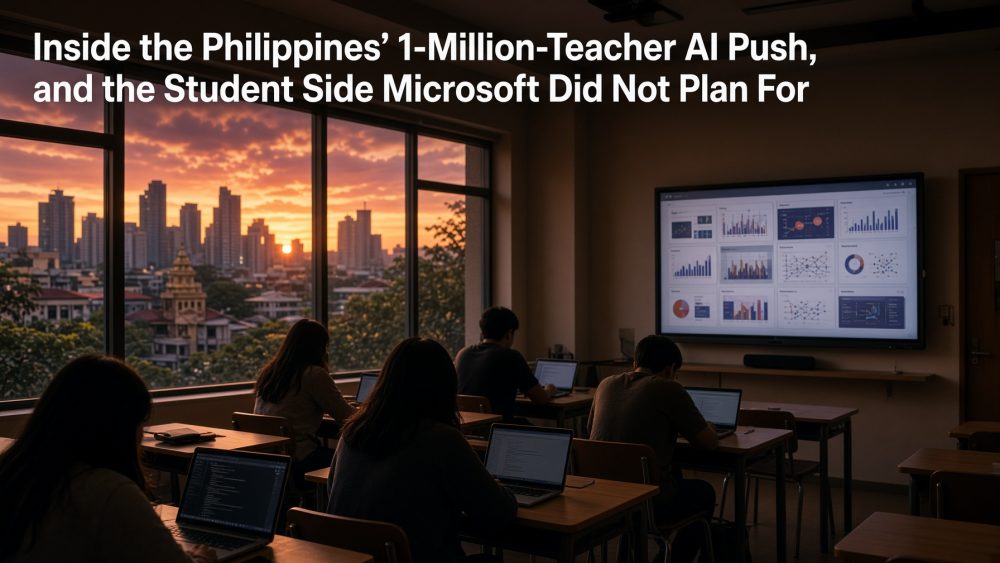
One million public-school teachers in the Philippines will receive Microsoft Copilot access by the end of 2026 under a new DepEd-Microsoft partnership, the largest classroom-AI rollout any Southeast Asian government has signed off on (Source: Microsoft, 2026). Two months later, the same students these teachers serve turned in PISA 2025 results that are the country's highest ever, while OECD analysts flagged Filipino learners as the most AI-dependent in the comparison set. The two stories are not a coincidence. They are the next chapter of Philippine education, and the chapter is being written in Manila, Cebu, and Davao classrooms right now.
What DepEd Actually Bought
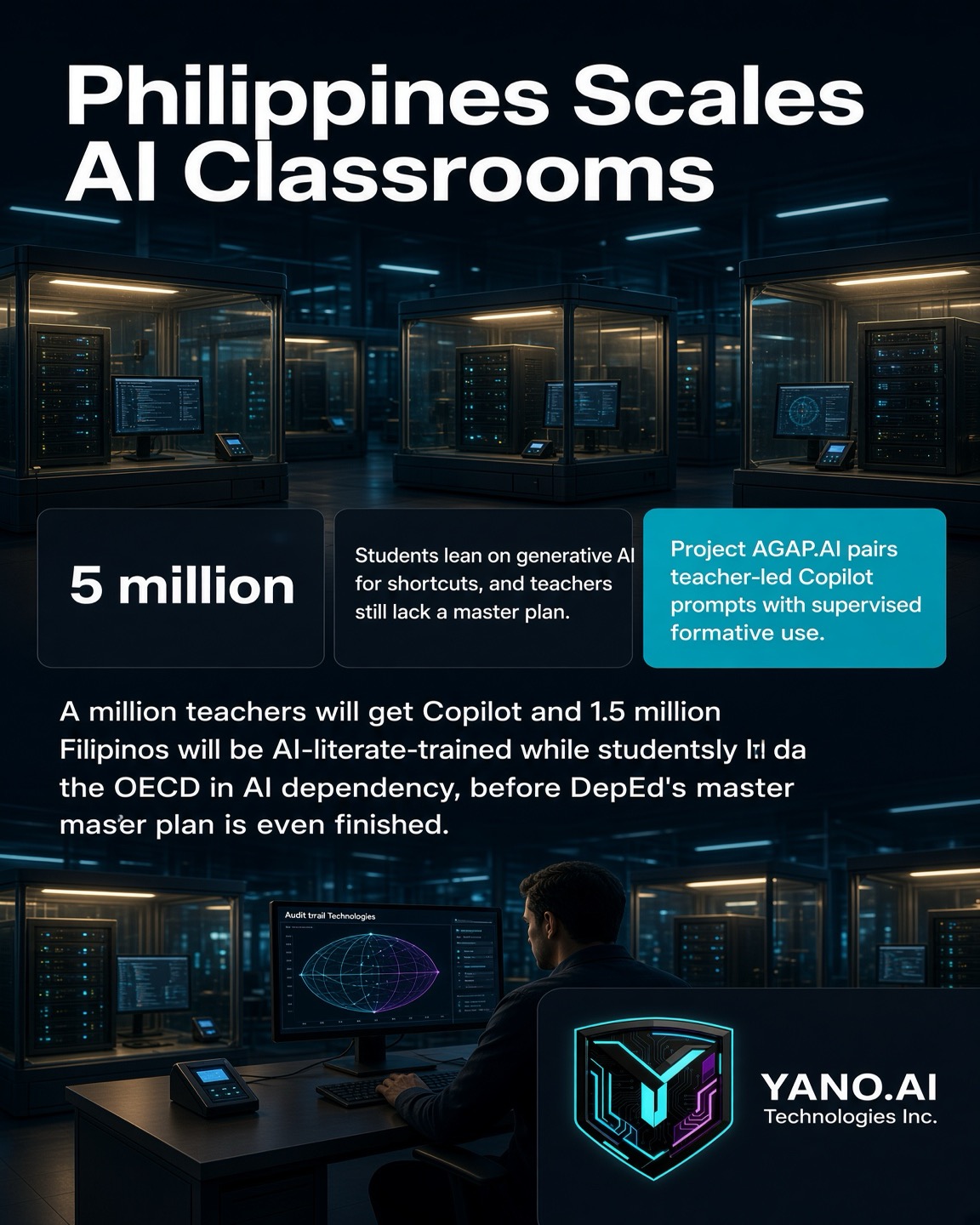
The August 2026 agreement equips one million public-school teachers with Microsoft Copilot licenses, plus training on prompt design, lesson planning, and assessment drafting. The package also funds a national AI-readiness program, Project AGAP.AI, that DepEd launched in January 2026 to give every school division a written policy on responsible classroom AI use (Source: Microsoft, 2026; Manila Bulletin, 2026). The full teacher cohort sits inside a broader DepEd target of training 1.5 million Filipinos in AI literacy before the school year closes (Source: BusinessWorld, 2026).
For a system that still runs on paper-based lesson logs in many barangay schools, this is a serious upgrade. Lesson-plan drafting that used to consume Sunday evenings can now be offloaded in minutes. Teachers gain a planning assistant that speaks Filipino and English and is already trained on the K-12 curriculum.
The PISA Signal Nobody Wants to Talk About
The numbers arrived in early September. Filipino 15-year-olds posted their highest reading, math, and science scores in PISA history, an outcome DepEd framed as proof that the post-pandemic learning recovery is real (Source: Rappler, 2026; ABS-CBN, 2026). Buried inside the same OECD report was a warning: Philippine students reported the highest AI dependency of any country in the comparison, using generative tools more often and more uncritically than their OECD peers (Source: BusinessWorld, 2026).
That detail reframes the entire story. A teacher who drafts a lesson with Copilot is using AI to teach. A student who finishes a worksheet with Copilot is using AI to skip learning. Both sides of the same technology are scaling in the same country at the same time, and DepEd's master plan for AI in schools is still being drafted (Source: Philstar, 2026).
What the EdTech Omnibus Policy Already Knew
This tension is not new. EdTech Hub's March 2026 review of the Philippines' EdTech Omnibus Policy warned that foundational literacy and numeracy tools often fail when they are deployed without teacher-led interpretation. Students in early grades need structured prompting, not free-form chat. The same risk is now repeating at secondary level with generative AI, where the line between scaffold and shortcut is invisible to the student (Source: EdTech Hub, 2026).
The policy answer is not to ban the tools. Project AGAP.AI's framework explicitly allows controlled classroom use under teacher supervision, and the new Copilot licenses include prompts for formative assessment rather than direct answer generation. The harder question is who teaches the students how to ask, how to verify, and when to stop.
Where Yano.AI Fits
A small set of Philippine AI builders are now shipping products designed for this exact gap. Yano.AI, founded in Quezon City, has been working with private schools and review centers on retrieval-based study assistants that quote the learner's own uploaded module rather than the open web. The model is built for the Filipino review culture, where students drill past papers and expect an answer that explains why the distractor is wrong. Used inside a school, it acts like a tutor that never invents. Used at home without a teacher, it is still safer than a general chatbot.
The pattern matters because the rollout question is no longer whether students will use AI. They already are. The question is whether the AI they reach for has been engineered to teach, or just to answer.
What Schools Should Do This Term
Three moves are worth making before the next PISA cycle. First, write an AI-use policy into the student handbook the same week Project AGAP.AI materials land, so the rule is in place before the homework questions start. Second, train teachers on prompt auditing, not just prompt writing, so they can read student submissions and spot where Copilot has replaced thinking rather than supported it. Third, separate the formative-assessment use case from the homework use case in the school's own data policy, so parents can see what the model was asked and which prompts were blocked.
The DepEd master plan will land eventually, but the schools that move first will own the next round of PISA results, not just chase them.
FAQ
Q: Is DepEd replacing teachers with AI?
A: No. The August 2026 Microsoft agreement equips teachers with Copilot as a planning and assessment aid. Project AGAP.AI explicitly requires teacher supervision for any student-facing AI use (Source: Manila Bulletin, 2026).
Q: Did Filipino students actually improve in PISA 2025?
A: Yes. Reading, math, and science scores were the highest the country has ever recorded (Source: Rappler, 2026; ABS-CBN, 2026).
Q: What does "AI dependency" mean in the PISA report?
A: It is a self-reported measure of how often students used generative AI tools during lessons and homework. The Philippines topped the comparison set, ahead of every OECD country (Source: BusinessWorld, 2026).
Q: When does the DepEd AI master plan come out?
A: It was still being drafted as of August 2026 and had no public release date at the time of writing (Source: Philstar, 2026).
Q: How is Yano.AI different from a general chatbot for students?
A: Retrieval-based study assistants answer from the learner's own uploaded module instead of the open web, which makes the answer auditable and removes the most common hallucination path.
Key Takeaway
The Philippines is now the world's largest live classroom-AI experiment. The Copilot rollout and the PISA dependency warning are two halves of the same announcement, and the schools that write the policy first will decide which half grows.
What does your school's AI-use policy look like today, and is it specific enough to answer the homework question in front of the student, not after it?
Sources
- https://news.microsoft.com/source/asia/2026/08/27/deped-and-microsoft-partner-to-advance-philippine-education-in-the-ai-era-equip-1m-teachers-with-microsoft-copilot/
- https://mb.com.ph/2026/01/09/deped-launches-project-agapai-to-guide-responsible-ai-use-in-basic-education
- https://bworldonline.com/education/2026/01/11/723422/deped-targets-ai-literacy-training-for-1-5-million-filipinos-in-2026/
- https://bworldonline.com/economy/2026/09/09/775790/phl-students-more-dependent-on-ai-than-peers-in-oecd-pisa/
- https://www.rappler.com/philippines/reading-mathematics-science-results-pisa-2025/
- https://www.abs-cbn.com/news/nation/2026/9/8/philippines-posts-highest-pisa-scores-yet-but-learning-gaps-remain-2105
- https://www.philstar.com/headlines/2026/08/05/2547129/deped-preparing-master-plan-ai-schools
- https://edtechhub.org/2026/03/30/designing-edtech-for-foundational-literacy-and-numeracy-insights-from-the-philippines-edtech-omnibus-policy/
Sources — external references open in a new tab.