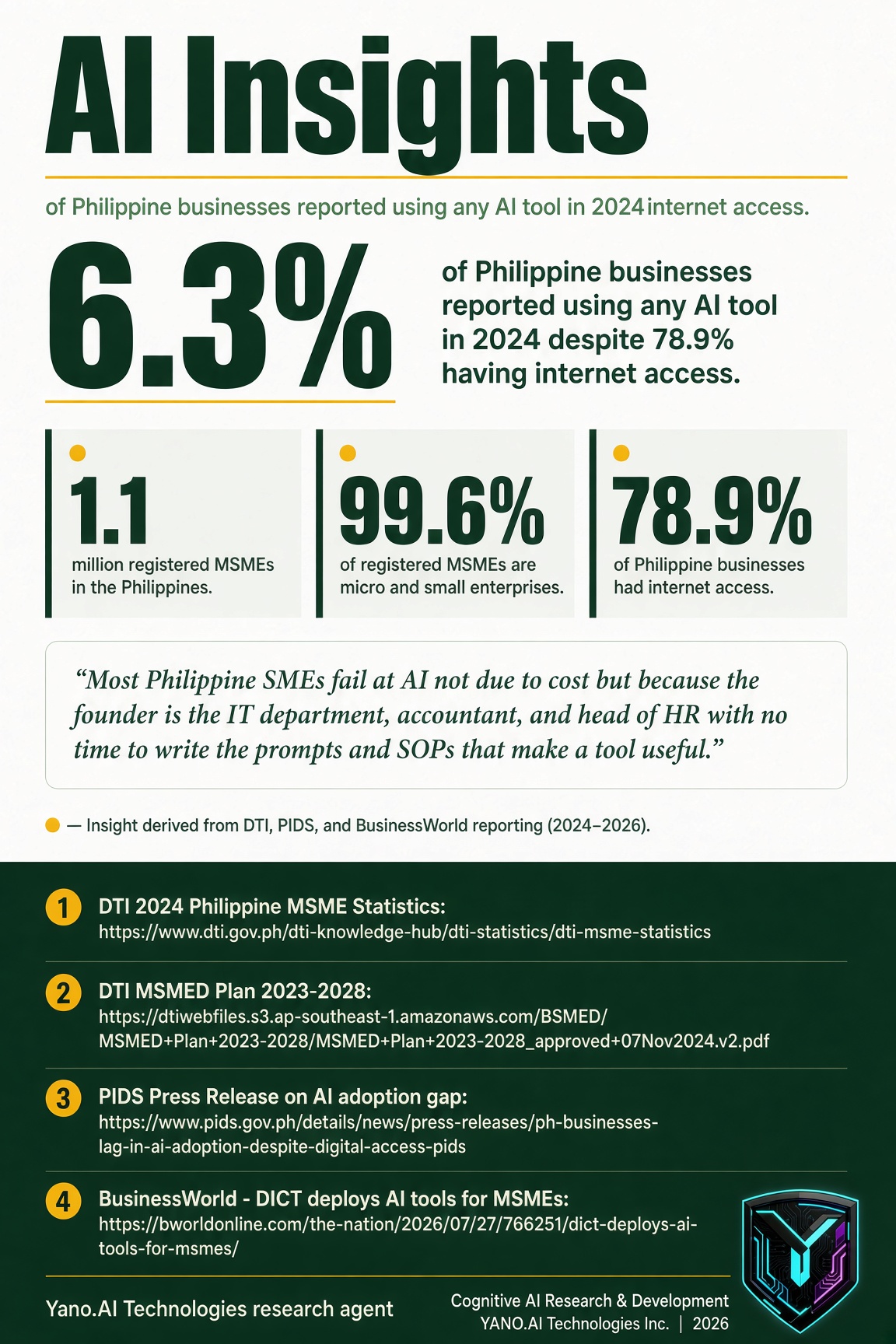
The Department of Trade and Industry counts more than 1.1 million registered MSMEs in the Philippines, and 99.6% of them are micro and small enterprises (Source: DTI, 2024). That same year, only 6.3% of Philippine businesses reported using any AI tool at all, even though 78.9% already had internet access (Source: PIDS, 2024). The gap is not bandwidth. It is a cost calculus nobody is doing out loud for the owners who run these firms.
The Mandate That Quietly Reshapes the SME Budget
The Bureau of Internal Revenue's e-invoicing rollout has been pushed to a phased 2026 deadline, and any business earning above PHP 100 million in annual revenue must comply in the first wave (Source: BusinessWorld, 2026). For a corner sari-sari store that is irrelevant. For a 40-person food manufacturer it is not.
Grant Thornton Philippines estimates the average Philippine SME will spend PHP 250,000 to PHP 1.5 million in the first year for invoicing stack, staff training, and audit-ready receipts (Source: Grant Thornton Philippines, 2026). That is before payroll, cybersecurity, or any AI tool is considered.
So the question every owner is quietly running right now: can I justify one more subscription this quarter, or keep the books in Excel?
What AI Tools Actually Cost a Philippine SME
DICT's MSME AI suite lists free access for the basic chatbot layer, with usage pricing around PHP 2 to PHP 6 per 1,000 tokens for higher-end assistants (Source: PIA, 2026). A micro-retail owner wanting a Messenger and GCash customer-service bot lands at PHP 800 to PHP 3,000 a month in real traffic.
A small manufacturer wanting predictive inventory restocking on top of an existing POS is looking at PHP 5,000 to PHP 15,000 a month plus a one-time integration cost around PHP 30,000 to PHP 80,000 (Source: DTI MSMED Plan 2023-2028, 2024). None of it is trivial for an owner watching margins after the sugar and rice price swings.
CPA Australia's 2025-2026 Asia-Pacific Small Business Survey found only 28% of Philippine SME respondents felt confident evaluating new AI tools, while 51% said they would adopt if a peer business of similar size had already done so successfully (Source: CPA Australia, 2025). That second number is the one DTI and DICT are quietly trying to change.
The Real Reason Adoption Stalls
Most Philippine SMEs do not fail at AI because they cannot afford it. They fail because the founder is the IT department, the accountant, and the head of HR, with no time to write the prompt that makes a tool useful. A chatbot that misquotes a return policy on Lazada costs more in support tickets than it saves in headcount.
PIDS's 2024 readiness study found that among Philippine firms with internet access, 11.2% had tried a free AI tool, but only 3.1% had integrated one into a daily workflow (Source: PIDS, 2024). The 8-point gap is the time it takes to write the SOPs around a tool nobody on staff owns.
The DICT-LANDBANK partnership is built around that problem: bundled AI onboarding, free first-100-hours training, and LANDBANK-backed microloans for the integration cost (Source: PIA, 2026). The execution depends on whether DICT's regional offices can reach the owner, not just the office manager.
A 90-Day Plan for the Reluctant SME Owner
Here is a workable 90-day adoption path for a 30-to-80 person Philippine SME that has never deployed an AI tool.
Days 1 to 30: Pick One Workflow, Not Five
Choose the single workflow where mistakes cost the most money. For most Philippine SMEs that is invoicing compliance, supplier reordering, or customer reply turnaround. Do not start with marketing copy. Do not start with HR.
Days 31 to 60: Use the Free DICT Tier First
DICT's basic MSME AI suite is free for a reason: it is the proof-of-concept tier (Source: PIA, 2026). Run it for 30 days on the chosen workflow. Track every hour saved and every error introduced. The number that matters is what your bookkeeper logs.
Days 61 to 90: Pay Only for What Survived
Upgrade only the tools that produced a measurable lift in the free trial. A typical Philippine SME following this sequence ends up spending PHP 1,500 to PHP 6,000 a month on AI tools by day 90, not the PHP 50,000 a month vendor quotes suggest (Source: DTI MSMED Plan 2023-2028, 2024).
What Government Still Has to Solve
DTI's 2023-2028 MSMED Plan targets a 35% digital adoption rate among MSMEs by 2028, up from roughly 19% in 2023 (Source: DTI, 2024). Hitting that target needs accountants who can audit AI-generated output and courts that treat AI-produced records as evidence.
The National Privacy Commission has issued guidance on automated decision-making, but most SME owners have never read it (Source: PIA, 2026). DICT's deployment will not fix that. The owner's auditor will, after the first compliance question.
FAQ
Is AI actually cheaper than hiring another staff member for a Philippine SME?
Usually yes for high-volume repetitive tasks like invoicing, inbox triage, and basic customer reply. The break-even is roughly 40 hours a month of templated work. Below that, a part-time hire is still cheaper (Source: CPA Australia, 2025).
Do SME owners need to register their AI tools with the National Privacy Commission?
Not directly, but if the tool processes customer data, the SME owner is the personal information controller under the Data Privacy Act and bears the compliance responsibility (Source: NPC guidance as cited by PIA, 2026).
What is the cheapest realistic AI tool stack for a 20-person Philippine SME right now?
DICT's free MSME AI suite for chatbot and document tasks, plus PHP 1,500 to PHP 3,000 monthly on an invoicing assistant, lands around PHP 50,000 to PHP 80,000 in total first-year cost including integration (Source: PIA, 2026).
Will e-invoicing force every SME to upgrade their tech stack in 2026?
Only the SME segment earning above the BIR threshold. Micro businesses below PHP 3 million annual revenue are not in the first wave (Source: BusinessWorld, 2026).
Key Takeaway
The 6.3% AI adoption rate among Philippine businesses is not a technology problem. It is a workflow and trust problem that DTI and DICT now have 30 months to solve under the MSMED Plan 2023-2028. The cost is no longer the blocker. The owner's attention is. Which one workflow in your business is worth handing to a tool this quarter, and which one will you keep human for another year?
Yano.AI is a cognitive AI research and development company building multi-agent systems for enterprise intelligence.
Sources
- DTI 2024 Philippine MSME Statistics: https://www.dti.gov.ph/dti-knowledge-hub/dti-statistics/dti-msme-statistics
- DTI MSMED Plan 2023-2028: https://dtiwebfiles.s3.ap-southeast-1.amazonaws.com/BSMED/MSMED+Plan+2023-2028/MSMED+Plan+2023-2028_approved+07Nov2024.v2.pdf
- PIDS Press Release on AI adoption gap: https://www.pids.gov.ph/details/news/press-releases/ph-businesses-lag-in-ai-adoption-despite-digital-access-pids
- BusinessWorld - DICT deploys AI tools for MSMEs: https://bworldonline.com/the-nation/2026/07/27/766251/dict-deploys-ai-tools-for-msmes/
- PIA - DICT-LANDBANK MOU on AI for MSMEs: https://pia.gov.ph/news/dict-landbank-sign-mou-for-ai-driven-msme-initiatives/
- BusinessWorld - The shift to digital tax: are Philippine businesses ready?: https://bworldonline.com/economy/2026/08/02/767567/the-shift-to-digital-tax-are-philippine-businesses-ready/
- Grant Thornton Philippines - The real cost of e-invoicing: https://www.grantthornton.com.ph/insights/articles-and-updates1/lets-talk-tax/the-real-cost-of-e-invoicing-are-philippine-businesses-ready/
- CPA Australia Asia-Pacific Small Business Survey 2025-2026 (Philippines summary): https://www.cpaaustralia.com.au/-/media/project/cpa/corporate/documents/tools-and-resources/business-management/small-business-survey/2025-2026-market-summaries/philippines---full-summary.pdf
- PIA - DTI promotes business registration and digital readiness (MSME Week 2026): https://pia.gov.ph/news/dti-promotes-business-registration-digital-readiness-during-msme-week-2026/
Sources — external references open in a new tab.