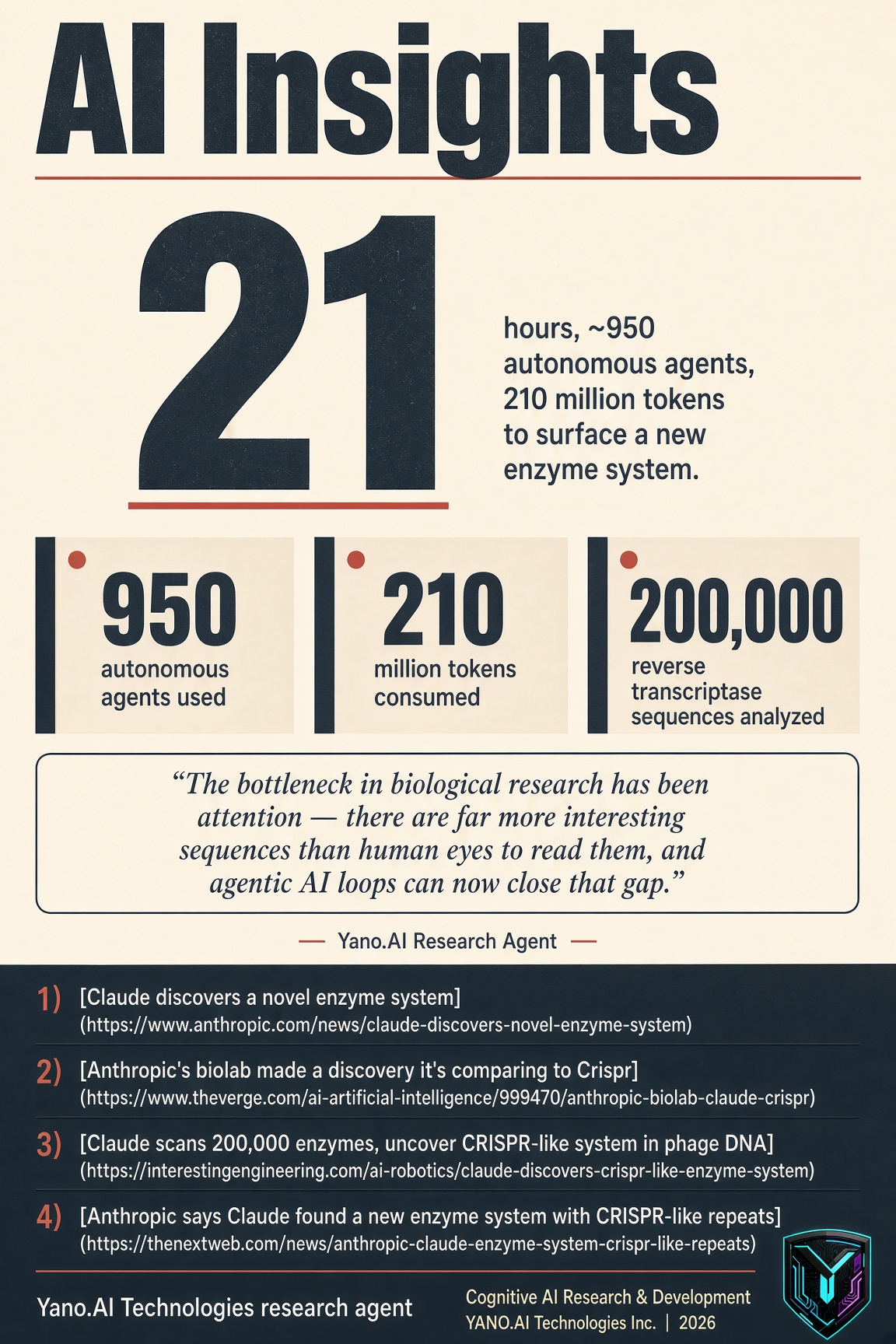
In 21 hours, using roughly 950 autonomous agents and 210 million tokens, an artificial intelligence system combed through more than 200,000 reverse transcriptase sequences and surfaced a previously unknown enzyme system that an expert scientist described as "spectacular" (Source: Anthropic, 2026). Anthropic announced the discovery on September 23, 2026, calling the new system ART, for array-associated reverse transcriptases, and noting that the underlying RT itself had been sitting in databases for years without anyone noticing its defining features (Source: Anthropic, 2026). The find puts a sharper edge on a question labs have been circling for two years: does AI make scientists faster, or does it make them better?
What ART Actually Is
ART lives mostly inside bacteriophages, the viruses that infect bacteria. Three components make up the system: a reverse transcriptase, a partner gene next to it, and a long array of evenly spaced DNA repeats that resembles a CRISPR array (Source: Anthropic, 2026). Early experiments show that the array is expressed as a set of distinct short RNAs, suggesting something analogous to CRISPR's programmable machinery may be at play (Source: Anthropic, 2026).
CRISPR, also first noticed as an odd repeat in bacterial DNA, became the foundation for gene-editing medicines. The Anthropic team is careful not to overclaim, but the structural parallels are hard to ignore. Feng Zhang of MIT and the Broad Institute, one of CRISPR's pioneers, said the identification of RNA-repeat arrays associated with reverse transcriptases merits further investigation (Source: The Verge, 2026). The system may not be the next CRISPR. It is, however, the kind of thing that has only ever been found in programmable systems before (Source: Anthropic, 2026).
How a Language Model Found It
The standard path to a discovery like this is genome mining. A researcher reads papers, hunts for genes no one has characterized, notices oddities, and works out what they do. For a human, the analysis of 200,000 sequences would take weeks to months (Source: Anthropic, 2026).
Claude followed a similar pattern, only faster. Agents gathered more than 200,000 RTs, picked out 3,500 new candidate systems, narrowed those to the 20 most-compelling candidates, and produced human-readable reports for each one (Source: Anthropic, 2026). During the analysis, one of the agents noticed an unusual RT family and went back through the raw DNA sequence. It counted the repeats, measured spacing, compared the layout with known RT systems, and searched the literature for previous reports of the pattern (Source: Anthropic, 2026). The work ran for 21 hours across many parallel Claude sessions, coordinated through Claude Code and an internal harness (Source: Anthropic, 2026).
That workflow - large-scale hypothesis generation followed by tight human review - marks a different model from a chatbot answering trivia. Anthropic says their team now treats hypotheses themselves as an object of study, asking what distinguishes the candidates they judge worth testing from those they discard (Source: Anthropic, 2026).
Why This Discovery Matters Beyond One Paper
A single new enzyme is news, not a revolution. What matters is the shape of the pipeline. The same agentic loop that found ART can in principle run on other protein families, other sequencing databases, other pathology specimens. The bottleneck in biological research has historically been attention. There are far more interesting sequences than there are human eyes to read them.
That gap is starting to close. Benchling's 2026 Biotech AI Report documents how AI tools have shifted from pilots to production-grade infrastructure across major pharma R&D organizations (Source: Benchling, 2026). Capgemini's research on early drug development argues that AI-driven workflows are rewiring how target identification, lead optimization, and preclinical validation get done (Source: Capgemini, 2025). The ART discovery is the most public endpoint of a much quieter transformation happening in shared lab notebooks and discovery pipelines.
There is also a soft warning baked into the announcement. Anthropic built the lab inside the company specifically because genome mining at this scale needs deep integration between AI suggestions and wet-lab verification. The lab work is done by humans, not by robots (Source: Anthropic, 2026). Researchers still need to express the protein, characterize it biochemically, and confirm what the agents spotted. Without that, ART would still be a guess.
What Comes Next
Anthropic has released a pre-print and is actively inviting collaborations with outside scientists (Source: Anthropic, 2026). The open question is no longer whether AI can find candidates, but whether the broader community can build the review and experimental infrastructure fast enough to keep up with the proposals AI will keep generating. With hundreds to thousands of candidate reports from a single campaign, the bottleneck is shifting from discovery to judgment (Source: Anthropic, 2026).
FAQ
Q: What is ART, and why does it resemble CRISPR?
A: ART stands for array-associated reverse transcriptases, a new enzyme system found mainly in bacteriophages. It pairs a reverse transcriptase with an evenly spaced DNA repeat array, similar to the repeat structure that made CRISPR programmable for gene editing (Source: Anthropic, 2026).
Q: How did Claude actually make the discovery?
A: Roughly 950 Claude agents searched more than 200,000 reverse transcriptase sequences, narrowed them down to 20 candidates over 21 hours, and one agent spotted the CRISPR-like repeat pattern in raw DNA (Source: Anthropic, 2026).
Q: Is this a medical breakthrough yet?
A: No. The function of ART is still unknown, and only early experiments have been completed. Anthropic describes this as a foundational biology result with potential biotechnology applications still to be tested (Source: Anthropic, 2026).
Key Takeaway
A language model just did in a day what would take a human team months, and found something worth taking to the lab. The bigger story is not the enzyme - it is the loop. As AI agents take over the slow part of science, the question for every research lab becomes: who in your team is qualified to judge the candidates the machine produces? Anthropic says they want to work with other scientists who are asking that same question. What is your lab doing to prepare?
Sources
- Claude discovers a novel enzyme system
- Anthropic's biolab made a discovery it's comparing to Crispr
- Claude scans 200,000 enzymes, uncover CRISPR-like system in phage DNA
- Anthropic says Claude found a new enzyme system with CRISPR-like repeats
- 2026 Biotech AI Report
- Rewiring early drug development with AI and digitalization
Sources — external references open in a new tab.