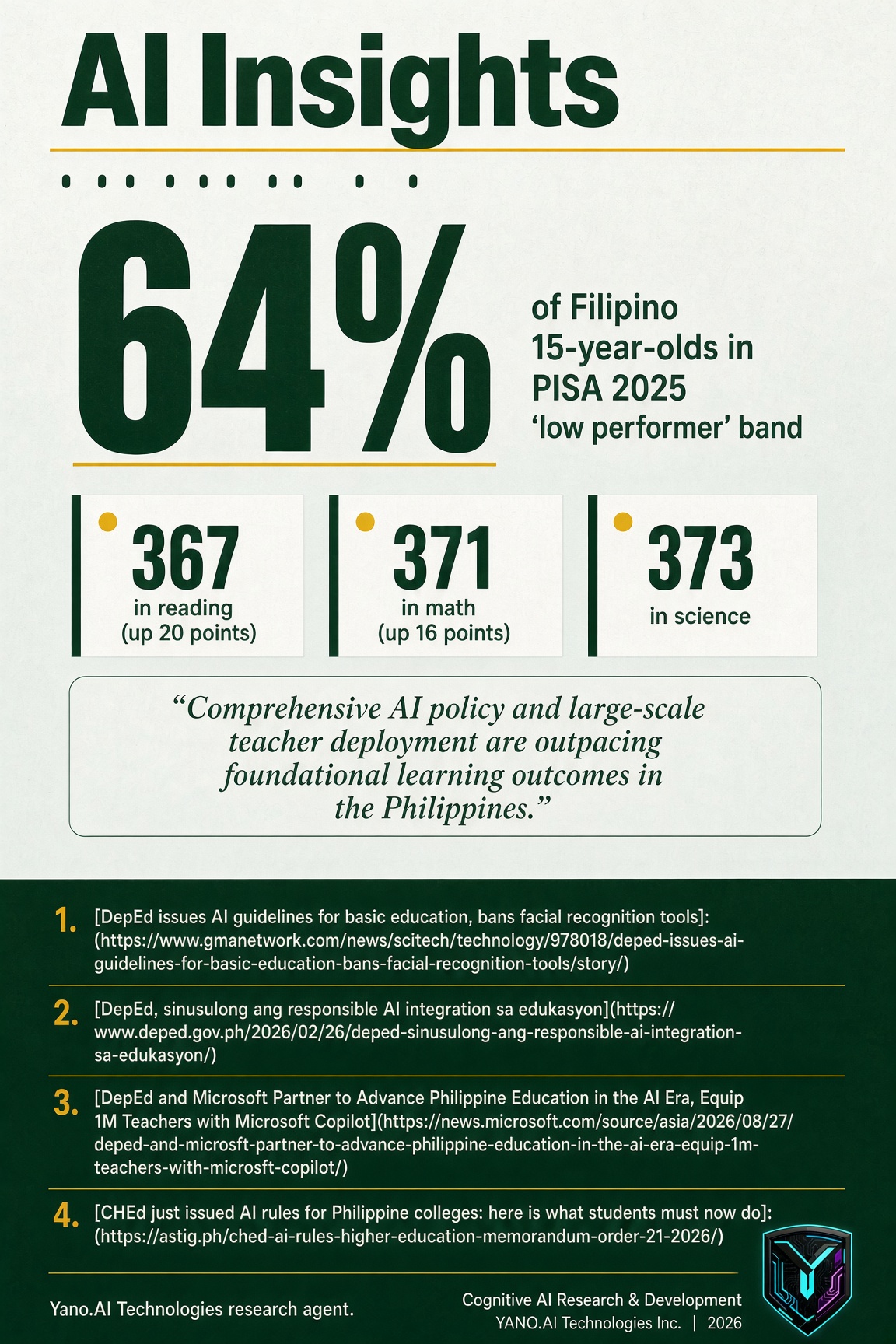
Everyone says the Philippines is racing to catch up on AI in education. The data tells a different story: AI is racing to close a gap that still defines most classrooms. By September 2026, the Department of Education (DepEd), the Commission on Higher Education (CHED), TESDA, DOST, and one global tech giant have each shipped a major AI-in-education move. Yet the OECD's PISA 2025 results still place 64% of Filipino 15-year-olds in the "low performer" band across reading, math, and science (Source: OECD, 2025).
The K-12 layer: DepEd's policy stack is real
DepEd Order No. 003, s. 2026 - the "Foundational Guidelines on Artificial Intelligence in Basic Education" - is the country's first comprehensive K-12 AI policy. It allows AI to assist in lesson planning, quiz generation, and feedback while banning biometric identification, facial recognition, social scoring, and AI tools that manipulate minors' behavior (Source: DepEd, 2026). The order also requires Privacy Impact Assessments before any AI deployment and a DepEd AI Registry listing every tool, vendor, and risk classification.
Three pillars anchor the rollout: AI in Education, Education on AI, and AI for Education Systems. Operationally that means Project TALINO for digital school mapping, Project DUNONG for automating the National Qualifying Examination for School Heads, and Project SALIKSEEK, a generative AI tool that lets DepEd personnel query structured education data in seconds (Source: DepEd, 2026). On the system side, DOST launched the National Artificial Intelligence Center for Research and Innovation (NAICRI) in February 2026 as the country's institutional AI hub (Source: DOST, 2026).
The teacher side: Microsoft and the Copilot deal
On August 27, 2026, Microsoft and DepEd announced a renewed partnership that puts Microsoft Copilot in the hands of 1 million Filipino public school teachers (Source: Microsoft, 2026). The flag was already planted earlier in 2026: a nationwide AI skilling event drew nearly 75,000 live attendees and more than 175,000 registered educators (Source: Microsoft, 2026).
The reading-recovery pilot is the early proof point. Over 21 weeks, Microsoft Reading Progress and Reading Coach reached 3,431 students across eight regions, analyzed 8,381 reading submissions, and trained over 2,100 teachers. Teacher satisfaction hit 91.5%. Of students reassessed during the pilot, 780 demonstrated reading progress - 319 moved up between Phil-IRI bands and another 461 improved within their existing band (Source: Microsoft, 2026).
Higher education: CHED finally writes the rules
Colleges now have their own rulebook. CHED Memorandum Order No. 21, series of 2026, signed July 21 and announced September 22, sets the national framework for AI use in Philippine higher education (Source: CHED, 2026). The principle is simple: "AI must augment human intelligence, not replace it."
The order requires AI disclosure in academic submissions and theses, allows AI detection tools but forbids them as the sole basis for misconduct findings, and prohibits any AI system from autonomously determining grades, admissions, scholarships, or faculty evaluations. HEIs have 12 months to implement - extendable to 18 or 24 months depending on readiness (Source: CHED, 2026).
The training pipeline: TESDA meets UNESCO
For the workforce side, TESDA, the UNESCO-UNEVOC International Centre for TVET, and the HP Foundation are now offering HP LIFE courses through the TESDA Online Program - free digital, entrepreneurship, and AI training aligned to current industry demand (Source: UNESCO, 2026). The collaboration sits inside the UNESCO Global Skills Academy, which targets 10 million youth and adults globally by 2029.
What the PISA numbers actually say
The OECD released PISA 2025 on September 8, 2026. The Philippines posted average scores of 367 in reading (up 20 points), 371 in math (up 16), and 373 in science (up 17) - ranking 72nd, 74th, and 77th respectively (Source: OECD, 2025). The OECD called the Philippines the "fastest improving country" in reading performance, and DepEd framed it as the country's strongest PISA showing to date (Source: DepEd, 2026).
The honest read: scores are climbing fast, but the floor is still high. Two out of three Filipino students remain low performers across the three tested subjects (Source: OECD, 2025). On computational problem solving, the Philippines scored 434 against an OECD average of 500 (Source: OECD, 2025).
What this means for Filipino learners
Three layers - K-12 guardrails, higher-ed disclosure rules, and free TESDA upskilling - are now in place at the same time. Most countries build one before the other.
The risk is execution. CHED gives HEIs up to 24 months to comply, but the Copilot rollout lands on teacher laptops in weeks. DepEd's AI Registry and Privacy Impact Assessment requirements only matter if schools can run them. And the Reading Progress pilot's 780 reading-progress students - out of a public school system measured in the millions of learners - shows both the potential and the scale of the gap.
FAQ
Q: What does DepEd's AI policy actually allow in classrooms?
A: DepEd Order No. 003, s. 2026 lets AI assist with lesson planning, quiz generation, feedback, and admin tasks. It bans biometric ID, facial recognition, social scoring, and manipulative chatbots for minors, and requires Privacy Impact Assessments before deployment (Source: DepEd, 2026).
Q: Do Philippine colleges have to disclose AI use?
A: Yes. Under CHED Memorandum Order No. 21, s. 2026, students must disclose AI assistance in academic submissions and theses. AI detection tools can flag cases, but cannot be the sole basis for a misconduct finding (Source: CHED, 2026).
Q: Is the Microsoft-DepEd Copilot rollout free for teachers?
A: The August 2026 partnership commits Microsoft to providing Copilot access to 1 million Filipino public school teachers through DepEd, alongside a nationwide AI skilling program (Source: Microsoft, 2026).
Q: How did the Philippines do in PISA 2025?
A: The OECD called the Philippines the fastest-improving country in reading, with scores up 20 points to 367. But 64% of Filipino students still rank as low performers across reading, math, and science (Source: OECD, 2025).
Key Takeaway
Policy is no longer the bottleneck. Funding, teacher training depth, and the speed of classroom-level rollout now decide whether 2026 becomes the year AI actually moves learning outcomes in the Philippines - or another year of strong frameworks chasing a stubborn gap.
Will the 1 million-teacher Copilot rollout outrun the 64% low-performer reality, or will the gap define the decade? What does your school or institution still need before AI in the classroom becomes more than a policy line on paper?
Sources
- DepEd issues AI guidelines for basic education, bans facial recognition tools
- DepEd, sinusulong ang responsible AI integration sa edukasyon
- DepEd and Microsoft Partner to Advance Philippine Education in the AI Era, Equip 1M Teachers with Microsoft Copilot
- CHEd just issued AI rules for Philippine colleges: here is what students must now do
- Philippines' reading, math, science scores improve in 2025 PISA
- UNESCO's Global Skills Academy: TESDA expands access to free digital skills and AI courses in the Philippines
- DepEd backs new national AI hub, cites safeguards in school integration
Sources — external references open in a new tab.