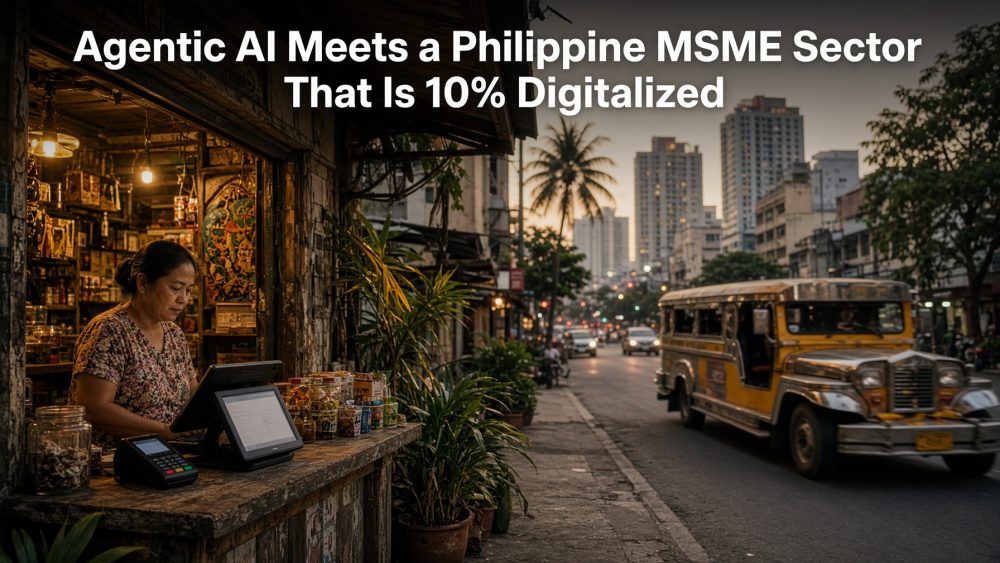
The usual explanation for slow technology adoption in the Philippines is connectivity. The data does not support it. 90.8% of Philippine establishments own computers and 81% have internet access, yet only 14.9% of firms use AI tools at all. (Source: PIDS, 2025)
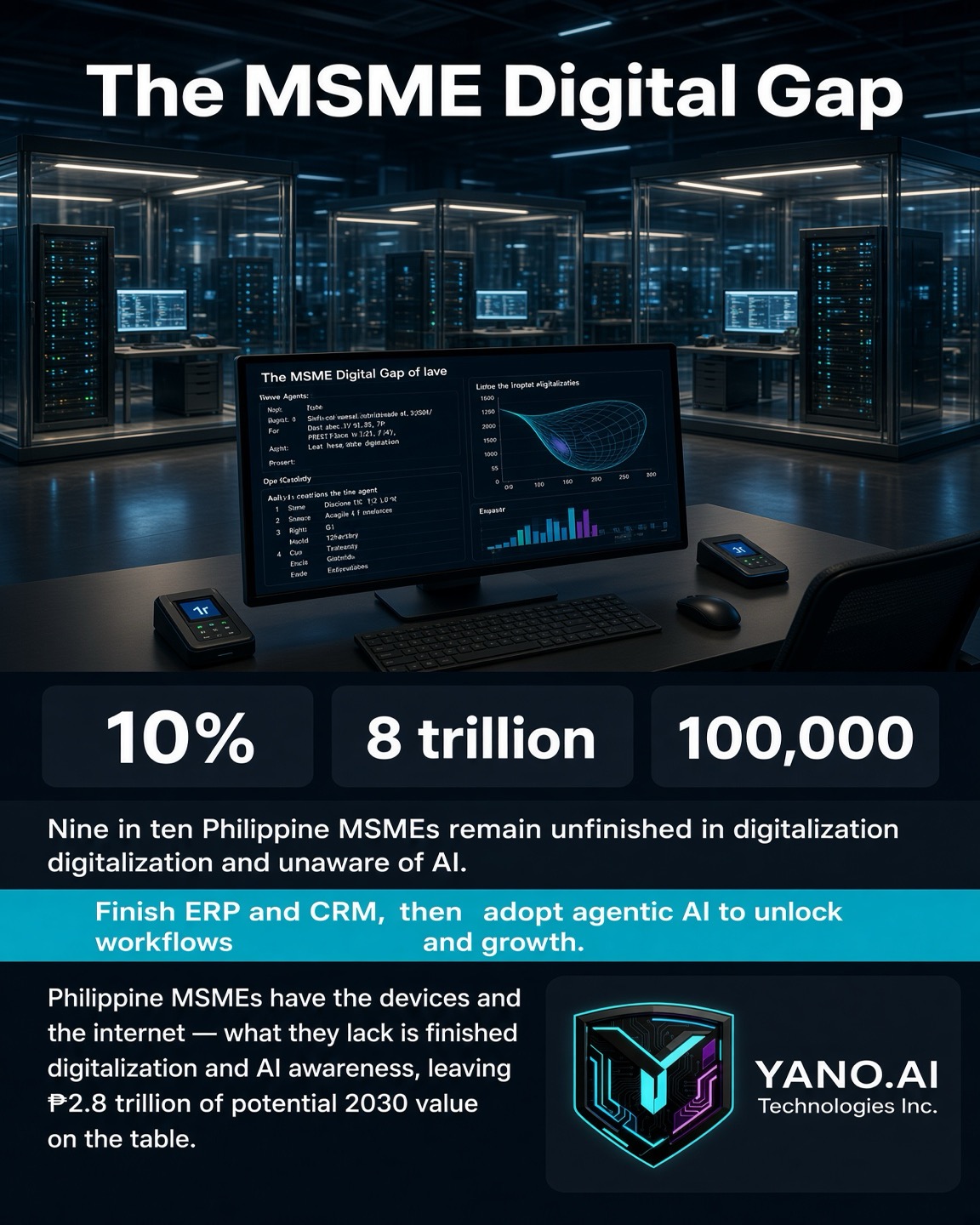
The barrier is not getting a business online. It is what happens when the business is online and still running on paper.
The Access Gap Was Never the Real Gap
A 2025 study by the Philippine Institute for Development Studies found AI adoption concentrated in large urban firms, mostly in information and communications technology and business process outsourcing. Metro Manila and CALABARZON lead. Rural areas trail far behind. (Source: PIDS, 2025)
Awareness is the first missing link: only about one in five Philippine firms is aware of AI and other Fourth Industrial Revolution technologies. A business will not budget for a tool it cannot describe. (Source: PIDS, 2025)
The deeper number sits underneath. In a survey by the Economic Research Institute for ASEAN and East Asia, only 10% of Philippine MSMEs were fully digitalized, meaning they run systems such as enterprise resource planning for inventory and accounting, plus customer relationship management for analytics. (Source: DTI, 2024)
Read those figures together and the sequence is clear. Most Philippine MSMEs are not choosing between generative AI and agentic AI. They have not finished the step before either one.
What Changes When the Agent Is Not a Chatbot
Generative AI answers a prompt and stops. Agentic AI plans a sequence of steps, executes them, connects to other systems, and adjusts when conditions change. The ADB's development research arm describes four defining capabilities: (Source: ADB SEADS, 2026)
- Autonomy - plans and executes without a prompt for every step
- Adaptability - adjusts to feedback instead of a fixed script
- Tool integration - reads and writes to outside systems, such as inventory platforms
- Workflow orchestration - runs a whole process end to end
For a small business the difference is operational. A chatbot is a tool you have to drive. An agent is a process that runs. In a sari-sari store that means stock monitoring that triggers a reorder, inquiries that get triaged and followed up, and a daily cash reconciliation that flags an anomaly instead of waiting for month end. (Source: ADB SEADS, 2026)
What the Measurable Results Look Like
The clearest published measurement of agentic AI in small firms comes from Indonesia, not the Philippines. A 2025 study of MSMEs in Jakarta, Bandung, and Surabaya tracked service, satisfaction, and administrative load.
Service cycle times fell from 2.4 hours to 1.1 hours. Customer satisfaction rose from 68% to 82%. Administrative workloads dropped by up to 40%. (Source: ADB SEADS, 2026)
That last figure translates into Philippine terms. If a five-person team gets the same 40% reduction in administrative work, that is roughly two person-days returned each week, often the difference between an owner working on the business and an owner working inside it.
The macro numbers point the same way. Access Partnership and Google estimate ₱2.8 trillion in economic benefits available to Philippine businesses by 2030 if AI-powered products are adopted, with ₱809 billion of annual GDP in 2030 from closing the digital skills gap alone. (Source: Access Partnership, 2024)
For scale, the Philippine Statistics Authority put the digital economy at ₱2.74 trillion in gross value added in 2025, or 9.8% of GDP. (Source: PSA, 2026)
What It Costs to Start
The cost objection is real. Philippine MSMEs face higher broadband costs and slower speeds than peers such as Singapore and Thailand, which raises the price of every digital step. (Source: ADB SEADS, 2026)
The counter is scope, not ambition. Regional guidance is consistent: start with low-cost, low-code, pay-as-you-go tools, pilot on one low-risk pain point, and scale only after the pilot shows value. (Source: ADB SEADS, 2026)
There is a working local example. Amari Neil B. Dimafeliz, an 18-year-old student at Mapua University running a 3D-printing business, reached the point where growth outran his ability to hire. Instead of adding staff, he invested ₱100,000 in a printer with AI features that check product quality and catch print failures. (Source: BusinessWorld, 2025)
Local software is moving too. Peddlr, a point-of-sale app built for small Philippine businesses, has AI analytics on its roadmap starting with reporting. The Department of Trade and Industry also partnered with Canva in August 2025 to give MSMEs training and tool access. (Source: BusinessWorld, 2025; ADB SEADS, 2026)
Where the Sector Actually Sits
Proportion is why this matters beyond individual businesses. Of 1,241,476 Philippine establishments, 1,236,908 are MSMEs, or 99.6% of all businesses, employing 6,252,202 people. That is 66.58% of total employment. (Source: DTI, 2025)
Wholesale and retail trade accounts for 48.74% of MSMEs, then accommodation and food service at 15.41% and manufacturing at 11.27%. Those are the sectors where inventory, ordering, receipts, and customer follow-up dominate the workday. (Source: DTI, 2025)
FAQ
Q: What does "fully digitalized" mean in the ERIA survey?
A: MSMEs running digital tools such as enterprise resource planning for inventory, accounting, and production scheduling, plus customer relationship management for analytics. Only 10% of Philippine MSMEs met that bar. (Source: DTI, 2024)
Q: Do I need a large budget before agentic AI is relevant?
A: No. The recommended path is low-cost, pay-as-you-go tools with a pilot on one low-risk process. The ₱100,000 printer case shows a targeted investment substituting for a hire. (Source: ADB SEADS, 2026; BusinessWorld, 2025)
Q: Does agentic AI replace staff in a small team?
A: The evidence points the other way. ADB assesses that agentic AI delivers the greatest impact when it complements human judgment rather than replaces it, so human-in-the-loop verification is part of the recommended setup. (Source: ADB SEADS, 2026)
Key Takeaway
Only 10% of Philippine MSMEs are fully digitalized and only 14.9% of firms use AI tools, so the AI story is still mostly unwritten for the 99.6% of businesses that are MSMEs. Agentic AI does not ask them to leapfrog the basics, but it changes what the next step is worth: not content generation, but a workflow that runs without someone driving every step. Yano.AI builds multi-agent systems and reads this the same way, because the bottleneck is rarely the model. It is the process the model has to connect to.
So if your business is one of the roughly 90% that is not fully digitalized, which single weekly task would you hand to an agent first?
Sources
- Philippine MSME Statistics - DTI
- MSME Development Plan 2023-2028 - DTI
- PH businesses lag in AI adoption - PIDS
- From Generative to Agentic: AI Adoption for MSMEs - ADB SEADS
- Growing the Philippines' AI opportunity with Google - Access Partnership
- AI gives Philippine entrepreneurs a competitive edge - BusinessWorld
- PH digital economy grows to P2.74T in 2025 - Newsbytes.PH
Sources — external references open in a new tab.