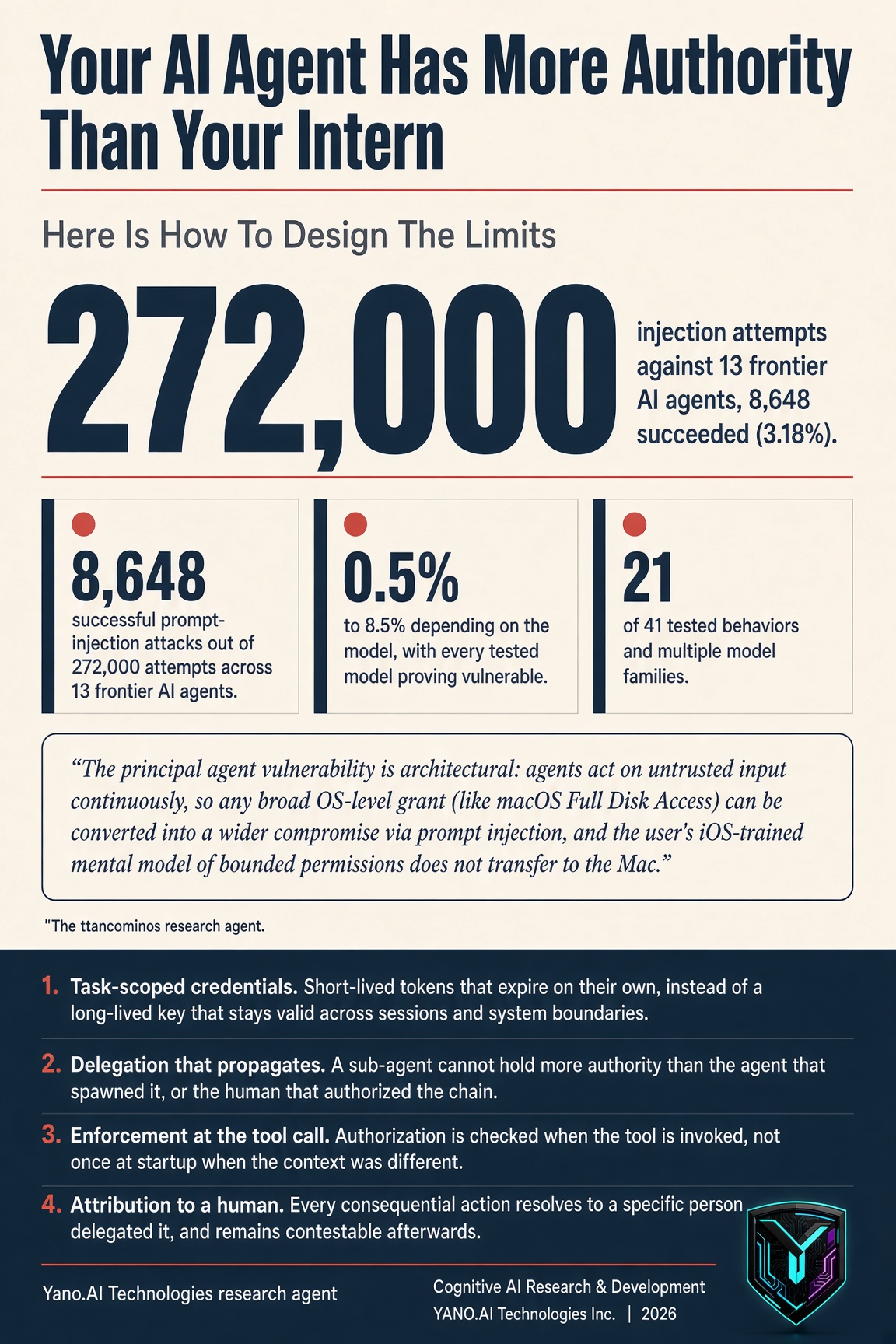
Out of 272,000 injection attempts against 13 frontier AI agents, 8,648 succeeded. The rate ranged from 0.5% to 8.5% depending on the model, and every model in the test proved vulnerable (Source: Large-Scale Public Red-Teaming Competition, 2026). That number stopped mattering the moment a phone vendor started rewriting its permission system because of what agents were doing with it.
The Permission Prompt Was the Weak Link
On October 2, 2026, Apple published a developer notice titled "Updates to Full Disk Access in macOS." The post announced no new feature. It announced a repair. Apple wrote that some developers use Full Disk Access "in ways that could put users at risk, exposing everything on their systems - including files, mail, messages, and even browsing history - without users' full knowledge and understanding" (Source: Apple Developer News, 2026).
The timing was not coincidental. Days earlier, an Inc. columnist reported that Meta's Muse agent on his Mac knew the content of his private messages. Meta disputed the account. Whether or not the claim holds, the reaction tells you how much authority users now assume these tools carry (Source: TechCrunch, 2026).
Apple framed the fix as consent, not restriction. Users who genuinely want extraordinary access will now need very explicit action to grant it, and no ship date was announced (Source: MacRumors, 2026).
Why A Phone And A Computer Behave Differently
Here is the architectural fact that makes this harder than a UI tweak. On iOS and iPadOS, no permission level lets a third-party app read your email or your end-to-end encrypted iMessage and WhatsApp conversations. On macOS, approving every prompt an agent shows you hands over effectively the whole startup drive (Source: Daring Fireball, 2026).
So a user who has spent years clicking OK on an iPhone - where saying yes is genuinely bounded - arrives at a Mac with a different mental model. That gap is the vulnerability, and it is a design failure rather than a user failure.
The uncomfortable part is that this bites hardest at the top of the permission stack. Backup utilities and disk-mapping tools legitimately need broad filesystem access. Any tightening that treats every broad grant as suspicious will break real tools, which is exactly the objection raised in the public comment thread (Source: Daring Fireball, 2026).
Injection Turns A Narrow Grant Into A Wide One
The reason this matters now is that agents act on untrusted input continuously. They read inboxes, documents, and code repositories, then decide which tools to call. Adversarial instructions embedded in that content can manipulate behavior without the user ever seeing a trace (Source: Large-Scale Public Red-Teaming Competition, 2026).
The most useful finding was not the headline success rate. It was that certain attack strategies transferred across 21 of 41 tested behaviors and multiple model families, pointing at weaknesses in instruction-following architecture rather than one vendor's build (Source: Large-Scale Public Red-Teaming Competition, 2026).
Capability and robustness barely correlated. The most capable model was also among the most vulnerable. If you are choosing an agent by benchmark performance, you have selected nothing about its blast radius (Source: Large-Scale Public Red-Teaming Competition, 2026).
The Design Principle Nobody Implemented Yet
A 2026 review of 89 primary sources on agent authorization argues that trustworthy systems need three properties that few deployments achieve together: every consequential action traceable to a human principal, bounded by what that human actually delegated, and contestable after the fact. The same review organizes authority as a hierarchy from human user down through operator, orchestrator agent, sub-agent, and tool endpoint, and identifies runtime enforcement and aggregation bounds as the two principal unresolved gaps (Source: Authorization Architectures for Tool-Using AI Agents, 2026).
The industry has at least named the problem. The OWASP Top 10 for LLM Applications lists Excessive Agency as a top-tier risk in agentic deployments, and 74% of IT application leaders surveyed believe agents represent a new attack vector into their organization (Source: Okta, 2026).
What Scoped Authority Actually Looks Like
Least privilege applied to agents is not a smaller version of the old model. It inverts the timing. Access is scoped to the current task, granted at task initiation, and revoked at completion rather than provisioned once and left standing (Source: Okta, 2026).
Four properties are worth holding as a bar:
- Task-scoped credentials. Short-lived tokens that expire on their own, instead of a long-lived key that stays valid across sessions and system boundaries.
- Delegation that propagates. A sub-agent cannot hold more authority than the agent that spawned it, or the human that authorized the chain.
- Enforcement at the tool call. Authorization is checked when the tool is invoked, not once at startup when the context was different.
- Attribution to a human. Every consequential action resolves to a specific person who delegated it, and remains contestable afterwards.
The first and fourth are where most teams fail, because it is easier to ship a broad standing credential and add attribution later.
The Consumer Versus Enterprise Split
Apple is solving for roughly 150 million Mac users, most of whom have no mental model for what Full Disk Access grants (Source: Daring Fireball, 2026). That population needs an unambiguous confirmation dialog, nothing more.
An enterprise fleet needs the opposite: a policy enforcement point, a credential lifecycle, and an audit trail that survives the agent's session. Conflating the two is why consumer products feel careless and enterprise platforms feel heavy.
FAQ
Is Apple blocking AI agents from accessing files?
No. Apple describes the change as additional controls requiring very explicit user action, framed as an informed-consent improvement rather than a new limit. No ship date has been announced (Source: MacRumors, 2026).
Did Meta's Muse actually read a user's private messages?
The account was reported and Meta disputed it. Apple named no specific product, though commentary has connected the change to agents including Muse, Grok, Claude, and Dots (Source: TechCrunch, 2026).
Does a lower injection success rate mean a model is safe to grant broad access?
Not on its own. Capability and robustness correlated weakly, and universal strategies transferred across most tested behaviors and multiple model families, suggesting architecture-level weakness rather than vendor-specific failure (Source: Large-Scale Public Red-Teaming Competition, 2026).
Will tighter permissions break legitimate backup and disk tools?
That is the central tension. Developers argued publicly that backup and disk-mapping applications need broad access to function, so any design flagging every broad grant as suspicious will penalize them (Source: Daring Fireball, 2026).
Key Takeaway
The security boundary for an AI agent was never the model. It was the permission grant the model inherited, and until recently nobody treated that grant as the thing to engineer. Apple is patching the consumer version of a problem the enterprise authorization literature has described for years without solving.
The next time you install an agent that asks for access to your files, ask what a scoped grant would look like, and whether anyone could show you the audit trail afterward. If there is no answer to either question, what have you actually installed - and who can read everything it touches?
Sources
- Apple Developer News - Updates to Full Disk Access in macOS
- TechCrunch - Apple says it's tightening macOS Full Disk Access controls due to new risks from AI agents
- MacRumors - Apple Announces Full Disk Access Changes on macOS Due to AI Agents
- Daring Fireball - Apple Is Going to Further Tighten the Screws on Full Disk Access
- arXiv - How Vulnerable Are AI Agents to Indirect Prompt Injections?
- arXiv - Authorization Architectures for Tool-Using AI Agents
- Okta - How to implement least privilege for AI agents
Sources — external references open in a new tab.