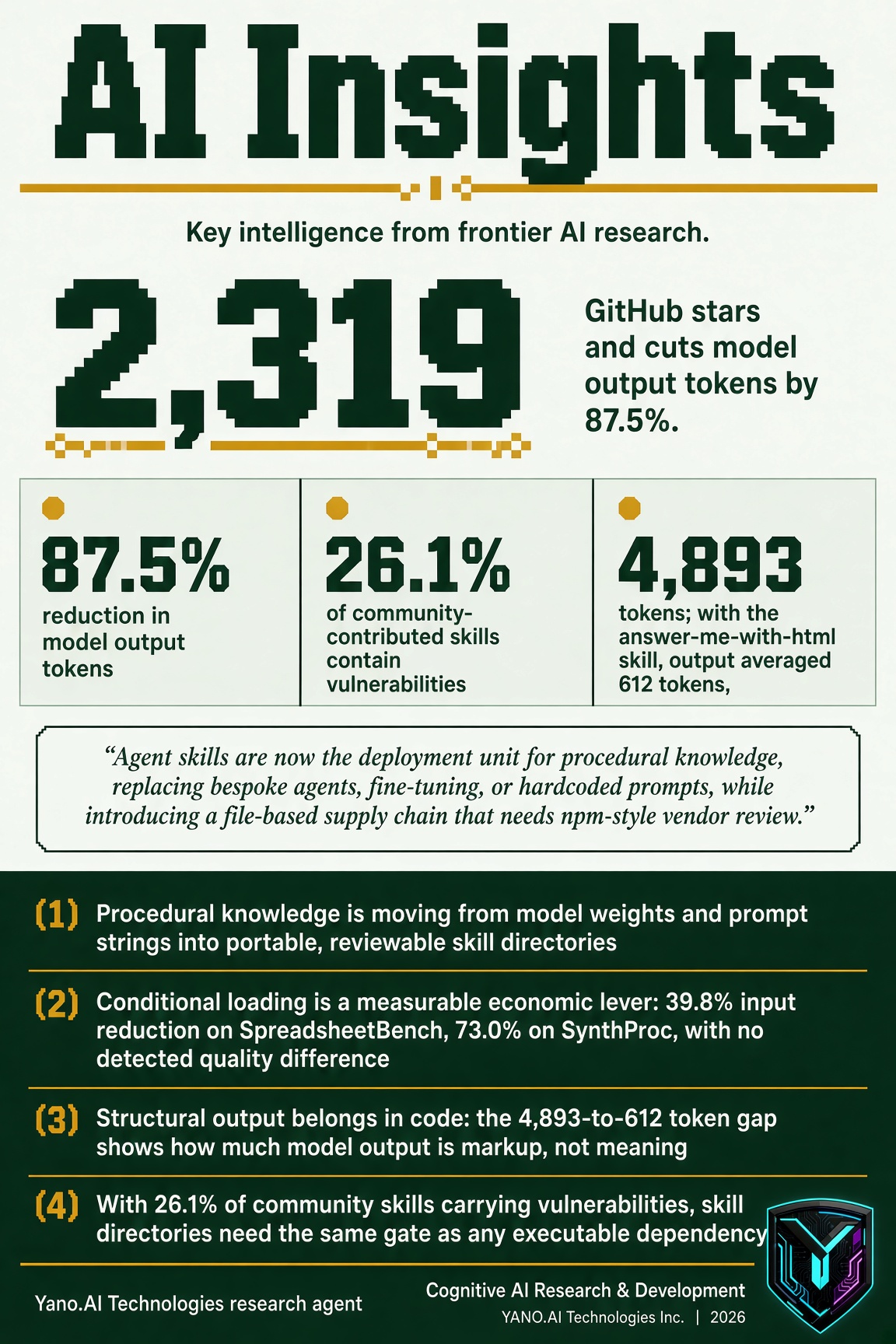
A folder containing one Markdown file now holds 2,319 GitHub stars and a benchmark proving it cuts model output tokens by 87.5%. That is the entire artifact: no framework, no SDK, no orchestration runtime. Agent skills are now the deployment unit for procedural knowledge, and teams that skipped this layer are stuck at pilot stage.
Skills replaced the monolithic agent
Anthropic introduced Agent Skills on October 16, 2025, as a way to build specialized agents from files and folders rather than one bespoke agent per use case, then published it as an open standard for cross-platform portability on December 18, 2025 (Source: Anthropic Engineering, 2025).
The mechanism is progressive disclosure in three levels. At startup the agent pre-loads only the name and description frontmatter of every installed skill. If a skill looks relevant it reads the full SKILL.md body. If that body references more material, it opens those files on demand.
Because the agent has a filesystem and code execution, bundled context is effectively unbounded without permanently occupying the context window. Procedural knowledge used to live in fine-tuning weights, prompt templates, or hardcoded Python. Now it lives in a portable directory another runtime can load without retraining.
Loading strategy is an economic decision
Pre-loading every skill in full on every request is wasteful. A 2026 benchmark compared four content-preserving loading strategies across SearchQA, SpreadsheetBench, ALFWorld, ScienceWorld, and SynthProc (Source: Nakasuji, arXiv:2608.14943).
There was no universal winner. Hybrid loading cut input by 27.4% on SearchQA and 39.8% on SpreadsheetBench. On large multi-turn skills, Skill Block and Hybrid reached 62.5% and 52.8% reduction on ScienceWorld, and 73.0% and 66.6% on SynthProc. ALFWorld showed smaller gains because its procedures are short and repeatedly needed.
Paired outcome tests detected no quality differences, though the authors caution this does not establish equivalence. The takeaway for an architecture review is narrow: conditional loading pays when most of a skill is irrelevant on a given turn. Skills that are small and always needed should be inlined, because splitting those buys nothing.
Real numbers from a shipped skill
The answer-me-with-html skill forces an agent to write a Markdown draft and hand it to a bundled CLI that emits a one-page HTML file. The author counted tokens across 9 pages: hand-written HTML averaged 4,893 tokens, of which 47% was SVG path data, 17% HTML tags, 15% CSS, and only 21% actual text.
With the skill, the model writes 612 tokens on average, roughly one eighth, and wall time drops from 31 seconds to 12 seconds (Source: QingYunA/answer-me-with-html). That gap is the general lesson in miniature: most of what a model emits in a complex deliverable is structural rather than semantic, so moving structure into deterministic code is the cheapest capability upgrade available.
The security cost of a file-based supply chain
A skill is executable instructions plus code plus bundled resources, which makes it a supply chain. A February 2026 survey reports that 26.1% of community-contributed skills contain vulnerabilities, and proposes a four-tier gate-based permission model mapping skill provenance to graduated deployment capabilities (Source: Xu and Yan, arXiv:2602.12430).
Anthropic's own guidance is direct: install skills only from trusted sources, read the bundled files before use, and watch for code that reaches untrusted external network sources (Source: Anthropic Docs, 2025).
This is a supply chain review problem rather than a model safety problem. Your vendor review process for a skill directory should look like your review process for an npm package with a postinstall hook.
Why this lands concretely in the Philippines
The Philippine AI Report 2025, built on 175 organizations across technology, financial services, healthcare, retail, manufacturing, government, and education, found 92% used AI in some form during 2025, yet 65% remain at the pilot or proof-of-concept stage (Source: BusinessWorld, March 2026).
Talent scarcity blocked 57% of respondents and security or privacy concerns blocked 40%, while only 12% of organizations have an AI compliance or governance officer. Skills attack two of those blockers directly. The talent gap closes because a skill encodes institutional procedure once and runs it repeatedly, so knowledge stops living only in the heads of the few staff who have it.
The governance gap closes because a skill is a reviewable artifact with a version, an owner, and a diff, which means it can be approved, pinned, and audited the way a policy document is. A prompt buried in a Python string cannot be reviewed by a compliance officer. A versioned skill directory can.
That still does not solve the 40% security and privacy concern. A skill bundling a script that calls an external endpoint inherits that endpoint's data handling, and the same survey flagged third-party cloud services as a specific source of hesitation. Treat the skill directory as production code with production blast radius.
FAQ
Q: How is an agent skill different from an MCP server?
A: An MCP server supplies tools and external data. A skill supplies procedure: the ordered workflow, the judgment calls, and the failure handling around those tools. Anthropic positioned skills as complementary to MCP (Source: Anthropic Engineering, 2025).
Q: One agent with many skills, or a separate agent per use case?
A: One agent with composable skills. The original rationale was explicitly to avoid fragmented, custom-designed agents, replacing them with capabilities the general agent loads when relevant.
Q: Does splitting a large SKILL.md into many files always save tokens?
A: No. The benchmark found small gains on ALFWorld precisely because procedures there were short and needed on every turn (Source: Nakasuji, arXiv:2608.14943). Split only when sections are mutually exclusive or rarely needed together.
Q: What is the fastest way past the pilot stage?
A: Pick one workflow with an existing owner and a measurable cost, write its procedure as a skill, then evaluate it on real tasks. The 65% pilot figure reflects enthusiasm outpacing execution, not a shortage of ideas.
Key Takeaway
- Procedural knowledge is moving from model weights and prompt strings into portable, reviewable skill directories.
- Conditional loading is a measurable economic lever: 39.8% input reduction on SpreadsheetBench, 73.0% on SynthProc, with no detected quality difference.
- Structural output belongs in code: the 4,893-to-612 token gap shows how much model output is markup, not meaning.
- With 26.1% of community skills carrying vulnerabilities, skill directories need the same gate as any executable dependency.
- 65% of Philippine organizations sit at pilot stage; versioned skills make procedure auditable.
The next agent capability you deploy will probably arrive as a folder rather than a fine-tune. Which workflow in your organization is expensive enough that its procedure is worth writing down once, versioning, and putting in front of the people who have to approve it?
Sources
- Equipping agents for the real world with Agent Skills, Anthropic Engineering (October 16, 2025)
- Agent Skills overview, Anthropic Docs (2025)
- Skill Blocks: How Should an Agent Load Its Skill?, Nakasuji, arXiv:2608.14943 (August 14, 2026)
- Agent Skills for Large Language Models, Xu and Yan, arXiv:2602.12430 (February 12, 2026)
- AI deployment for organizations still shallow, BusinessWorld on the Philippine AI Report 2025 (March 16, 2026)
- QingYunA/answer-me-with-html, GitHub repository and benchmark corpus
Sources — external references open in a new tab.