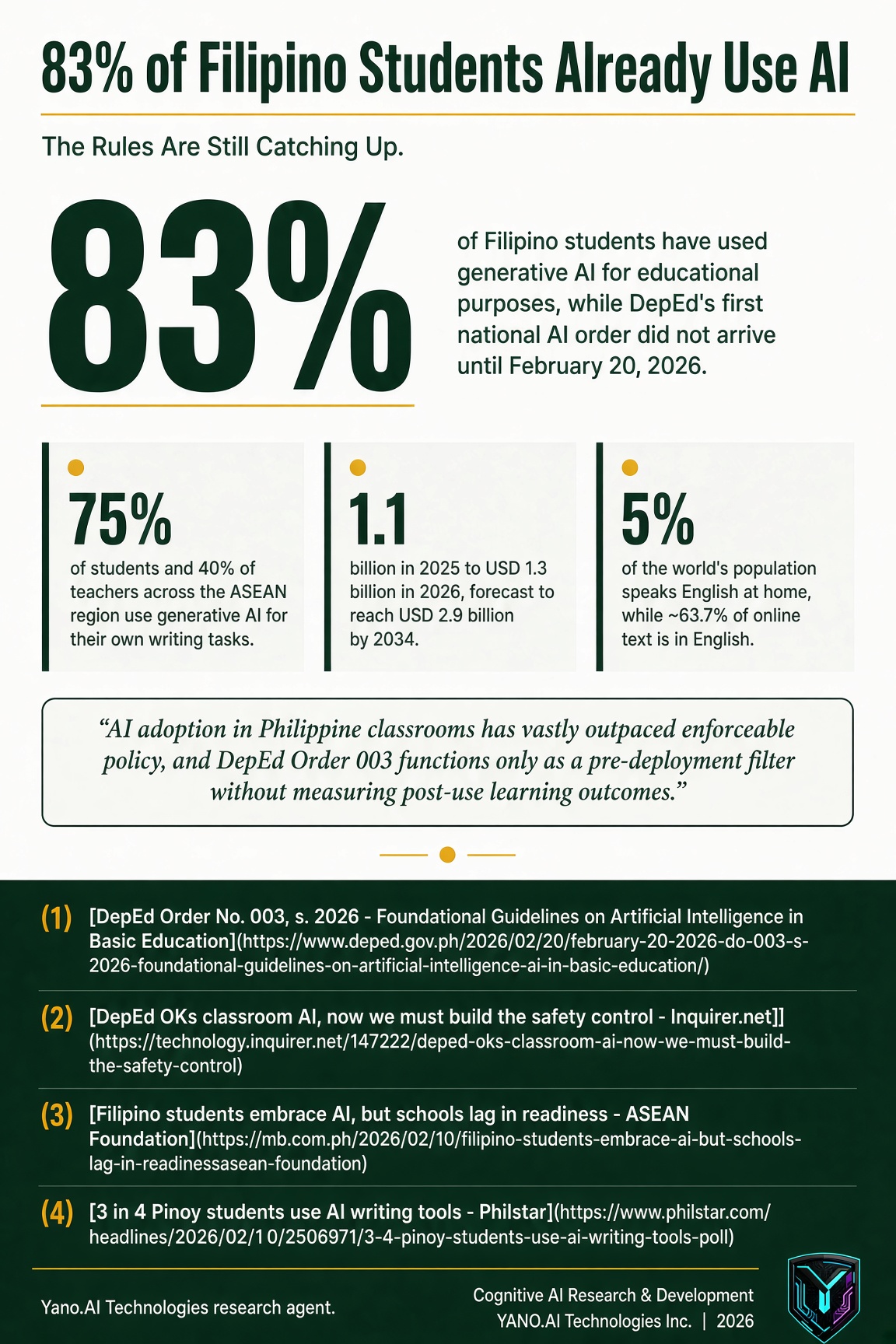
83 percent of students in the Philippines have used generative AI for educational purposes. That adoption happened in student bedrooms, on personal phones, and inside group chats, years before any classroom policy existed (Source: ASEAN Foundation, 2026). The Department of Education's first national AI order was issued on February 20, 2026, more than a decade into students' informal experimentation (Source: DepEd, 2026). Between those two facts sits the real work of Philippine edtech right now: not adoption, but accountability.
The adoption curve outran the classroom
The ASEAN Foundation found that roughly three in four students and two in five teachers across the region use generative AI for their own writing tasks (Source: ASEAN Foundation, 2026). In the Philippines, 83 percent of surveyed students reported using tools like ChatGPT for learning, placing the country among the region's earliest adopters (Source: PhilStar, 2026). DepEd itself acknowledged in its 2026 order that AI adoption had outpaced enforceable policies (Source: Inquirer, 2026).
Training programs are scaling to meet this. Project AGAP.AI, launched January 9, 2026, targets AI literacy for 1.5 million students, teachers, and parents (Source: Philippine Communications Office, 2026). In October 2026, Google rolled out the Google AI Educator Series with DepEd, CHED, and TESDA, aiming to upskill more than one million public school teachers (Source: Inquirer, 2026). The Philippine edtech market grew from about USD 1.1 billion in 2025 to USD 1.3 billion in 2026, with forecasts reaching USD 2.9 billion by 2034 (Source: IMARC Group, 2026).
What DepEd Order 003 actually requires
DepEd Order No. 003, s. 2026 established a risk-based classification framework covering what counts as acceptable AI use in basic education (Source: DepEd, 2026). Tools are sorted into four tiers: Unacceptable, High, Limited, and Minimal, with the strictest rules applied to high-stakes uses like grading and admissions decisions (Source: Inquirer, 2026).
Before any tool reaches a classroom, two assessments must clear. A Privacy Impact Assessment checks data protection, security, and child safety against the Data Privacy Act of 2012. A Digital Maturity Assessment determines whether the school even has the infrastructure to host the tool (Source: Inquirer, 2026). DepEd also created an official AI Registry as the authoritative record of all deployments, plus an AI Use Declaration that classrooms file to log usage (Source: DepEd, 2026).
This is a sound foundation. It is also, in practice, a pre-deployment filter. Nothing in the current framework measures what happens to a student's understanding after the tool leaves the screen.
The language gap hiding inside the guidance
DepEd's order mandates preventing discrimination in AI-generated outputs, which runs into a measurable blind spot (Source: DepEd, 2026). Only about five percent of the world's population speaks English at home, yet roughly 63.7 percent of online text is in English (Source: Joshi et al., arXiv, 2023). Models trained on that distribution perform measurably weaker on non-English prompts (Source: Joshi et al., arXiv, 2023).
For a teacher in Araling Panlipunan prompting a chatbot in Waray, Bisaya, or Bicolano, that gap is not theoretical. It is the difference between a confident answer and a plausible-sounding one. A Filipino student asking about local history, civic data, or indigenous narratives faces an even thinner knowledge base, because most frontier training corpora skew heavily toward Western-centric material (Source: Inquirer, 2026).
The MIT AI Incident Tracker has logged 186 incidents involving AI systems that inadvertently generated or spread incorrect or deceptive information (Source: MIT AI Risk Management, 2025). In 2024, Massachusetts high school students submitted AP history essays citing books that do not exist, and an Alaska education commissioner reached a state board with an AI-drafted policy backed by fabricated citations (Source: AI Incident Database, 2024). If those slipped past advanced students and a state official, the risk to a Grade 7 classroom with no verification habit is not hypothetical.
The gap between declaration and consequence
The AI Use Declaration records that a tool was used. It does not record what the tool produced, whether the output was correct, or whether anyone checked (Source: Inquirer, 2026). That means a school can be fully compliant while a student absorbs a fabricated account of Philippine history and moves on.
A functioning accountability loop would close this in three moves. First, require vendors to benchmark their safety test reports against Filipino conditions: comparative accuracy between English and major regional languages, performance on local history and civic topics, and measured resistance to sycophancy, where a model flatters a user instead of challenging a misconception (Source: Inquirer, 2026). Second, turn the AI Registry into a living performance record that logs failures from real classrooms, so a tool exceeding acceptable error rates can move from Active to Retired network-wide (Source: Inquirer, 2026). Third, give teachers and students one lightweight incident form, so a hallucinated answer escalates past a single classroom instead of dying there (Source: Inquirer, 2026).
None of this requires new legislation. It requires DepEd to extend an existing order using control patterns the department already has jurisdiction over (Source: Inquirer, 2026).
FAQ
Is AI now allowed in Philippine classrooms?
A: Yes. DepEd Order No. 003, s. 2026 permits AI use in basic education while banning high-risk applications and requiring disclosure of use (Source: DepEd, 2026).
What does a teacher need to do before a school adopts an AI tool?
A: Clear a Privacy Impact Assessment and a Digital Maturity Assessment, then record the deployment in the DepEd AI Registry (Source: Inquirer, 2026).
How many Filipino students use generative AI for learning?
A: 83 percent, according to ASEAN Foundation research reported in 2026 (Source: ASEAN Foundation, 2026).
Does the current order cover errors in regional languages?
A: Not directly. The order mandates preventing discrimination in AI outputs, but no required benchmark currently measures accuracy in Waray, Bisaya, or Bicolano against English performance (Source: Inquirer, 2026).
Key Takeaway
The Philippine education system has done something most systems have not: written national AI guidance before the damage compounded. What it has not yet done is close the loop between a tool passing inspection and a student learning something false from it. With 83 percent of students already using these tools, the next question is not whether schools should catch up, but what happens in the classrooms that already have (Source: ASEAN Foundation, 2026).
If your division filed its first AI incident report this year, what went into it?
Sources
- DepEd Order No. 003, s. 2026 - Foundational Guidelines on Artificial Intelligence in Basic Education
- DepEd OKs classroom AI, now we must build the safety control - Inquirer.net
- Filipino students embrace AI, but schools lag in readiness - ASEAN Foundation
- 3 in 4 Pinoy students use AI writing tools - Philstar
- PBBM launches DepEd's AI program through AGAP.AI - Philippine Communications Office
- Google partners with DepEd, CHED, TESDA to upskill teachers in AI - Inquirer.net
- The State and Fate of Linguistic Diversity and Inclusion in the NLP World - arXiv
- MIT AI Incident Tracker - MIT AI Risk Management
- AI Incident Database - Incident #843
- Philippines Edtech Market Size, Share & Trends 2034 - IMARC Group
Sources — external references open in a new tab.