Philippines digital payments hit 64.7% of all retail transaction volume in 2025 - roughly 3.9 billion electronic transactions, per the Bangko Sentral ng Pilipinas (Source: Bangko Sentral ng Pilipinas, 2026). In that same year, a survey by the Global Anti-Scam Alliance, Gogolook, and Mastercard put estimated scam losses among Filipino adults at P121.8 billion (Source: GASA/Gogolook/Mastercard, 2026). Two numbers, one payment rail, one country.
That pairing is the whole story of Philippine fintech right now, and almost nobody is saying it plainly.
The adoption win is real, and it is enormous
The BSP's 2025 e-payments measurement recorded 6.09 billion total retail transactions, of which 3.94 billion were digital (Source: Bangko Sentral ng Pilipinas, 2026). In value terms digital accounted for 53.3% of the PHP 234.57 trillion in retail payment volume.
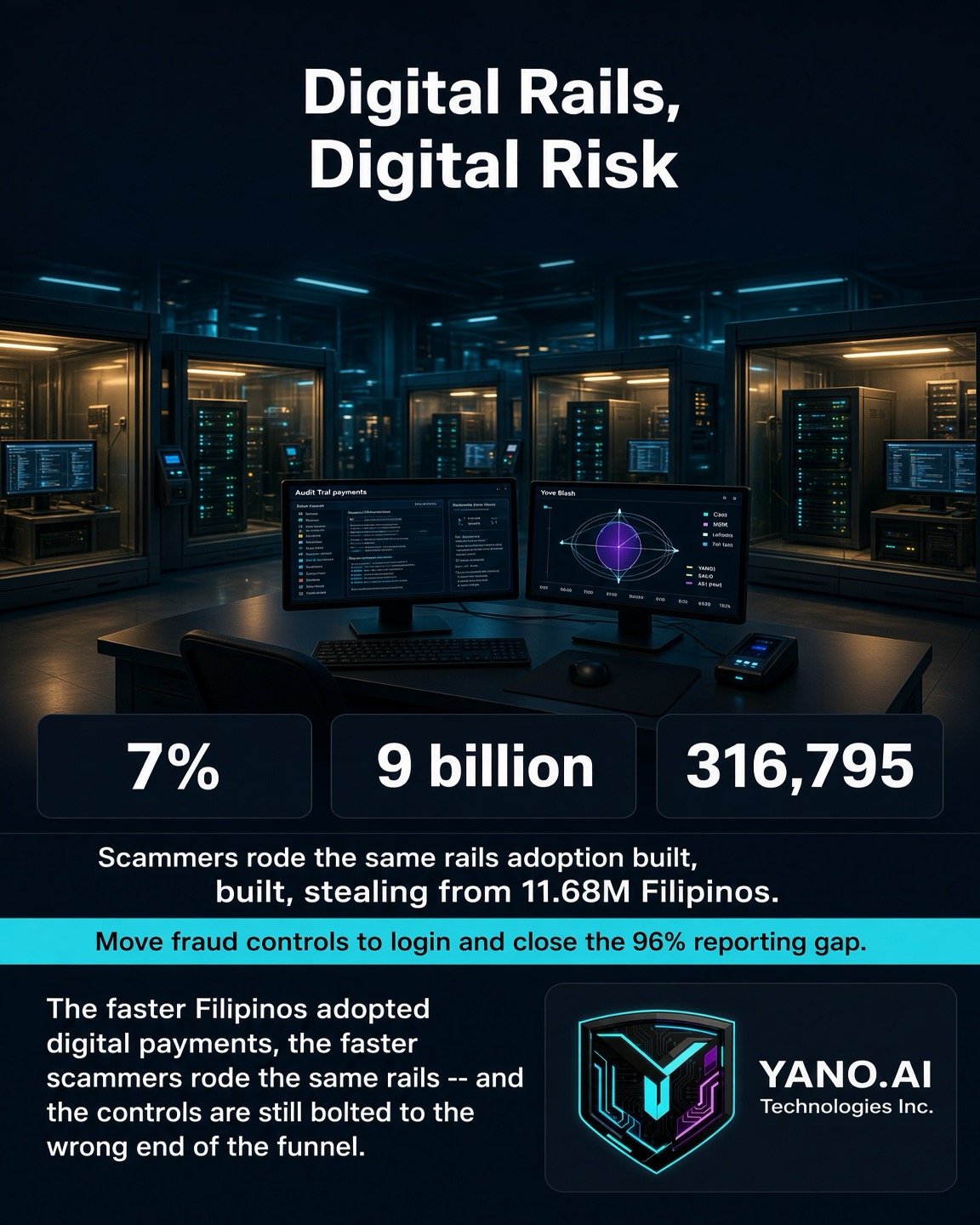
The infrastructure grew to match. Total payment acceptance terminals rose 12.90% to 316,795 in 2025, with mobile POS devices jumping 20.52% to 168,565 units (Source: Bangko Sentral ng Pilipinas, 2026). Merchant payments alone made up 95.69% of all digital transactions, or 3.77 billion of them.
Government-to-person payments are effectively fully digital at 98.92% by volume, and person-to-consumer sits at 74.91% (Source: Bangko Sentral ng Pilipinas, 2026). This is a genuine achievement. A country where cash once dominated now moves most of its retail volume electronically.
Now the number nobody says out loud
The GASA survey covered 1,160 Filipino adults. Of those, 165 - about 15% - reported losing money to scams. Scaled against the population, that share maps to an estimated 11.68 million adults (Source: GASA/Gogolook/Mastercard, 2026). Average reported loss was P10,426.90, though the median was a far more painful P2,200.
That gap between mean and median says losses concentrate in a smaller number of badly-hit households while most victims lose amounts individually small and collectively enormous. Brian D. Hanley, GASA's Asia-Pacific Director, put it plainly: P10,000, or even P2,000, can mean a lot to a family already struggling in this economy.
Exposure is rising, with 84% of respondents encountering a scam in 2025, up from 77% the prior year. But only 4% reported it to authorities. The reporting gap is where the losses get to stay.
The payment method shift nobody planned for
Here is the detail that should worry every fintech product team in the country. The dominant way Filipino victims send money to a scammer is now digital or e-wallet at 73%, up sharply from 34% a year earlier, while traditional bank and wire transfers fell to 12% from 36% (Source: GASA/Gogolook/Mastercard, 2026).
The same instant-payment rails that won the adoption campaign are now the primary extraction mechanism for fraud. Consumer protection did not fail to keep pace with adoption - it got lapped by it. Meanwhile 88% of scam attempts occurred on platforms with a Direct Message function, with SMS the top contact channel at 69% (Source: GASA/Gogolook/Mastercard, 2026).
Fraud is an identity problem, not a transaction problem
TransUnion's data sharpens this considerably. The Philippines' suspected digital fraud rate was 4.1% in 2025, above the 3.8% global level for the sixth consecutive year (Source: TransUnion, 2026). Nearly three-quarters of Filipino consumers (72%) reported being targeted by digital fraud attempts, against 53% globally.
The most revealing number sits in the lifecycle breakdown. Fraud risk was highest at account login at 6.1%, well above the 4.3% global rate, while account creation was 4.5% and financial transactions only 1.1% (Source: TransUnion, 2026). The transaction itself is not where the risk lives. The doorway is.
Phishing led reported schemes at 45%, followed by smishing at 38% (Source: TransUnion, 2026). With 91% of Filipinos managing at least some account administration online, attackers have a large surface to work against. Yogesh Daware, Chief Commercial Officer of TransUnion Philippines, frames it directly: fraud in the Philippines is fundamentally an identity issue, driven by impersonation and synthetic identities.
A BSP study reached a compatible finding, identifying social engineering, hacking, and card fraud as the leading cyber risks to the Philippine financial system (Source: BSP via Philstar, 2026).
Why AI agents sharpen this specific problem
Banks have already flagged AI-assisted attacks. BPI warned that criminal groups are combining IMSI catchers with artificial intelligence to target Philippine digital banking customers (Source: Philstar, 2025). The industry concern is no longer whether attackers use AI, but that AI collapses the cost of running thousands of personalized, multilingual, perfectly-timed impersonation conversations simultaneously.
That matters here because the dominant fraud channel is not a phishing email in an inbox. It is a direct message thread. Adversaries good enough to hold a convincing conversation over Messenger are already winning 44% of the time, the share of respondents who engaged with a scammer at all (Source: GASA/Gogolook/Mastercard, 2026).
The structural answer already exists on paper
Republic Act No. 12010, known as the Anti-Financial Account Scamming Act, was enacted specifically to penalize financial account scamming and set enforcement mechanisms (Source: Philippine Supreme Court E-Library, 2024). Deputy Governor Mamerto Tangonan has framed trust as central to digital transformation, citing AFASA directly (Source: Bangko Sentral ng Pilipinas, 2026).
The GASA survey recommends creating a National Anti-Scam Hub as a single coordinating authority for reporting, triage, and accountability (Source: GASA/Gogolook/Mastercard, 2026). TransUnion separately runs a Fraud Industry Council in the Philippines, launched in November 2024, convening banks and other players to share fraud intelligence (Source: TransUnion, 2026).
The unresolved question is enforcement reach. You cannot recover money from 96% of victims who never file a report, and the identity layer - not the transaction layer - is where the breach happens.
FAQ
Q: What percentage of Philippine retail payments are digital?
A: 64.7% by volume and 53.3% by value in 2025, per BSP's annual e-payments measurement (Source: Bangko Sentral ng Pilipinas, 2026).
Q: How much did Filipinos lose to scams in 2025?
A: An estimated P121.8 billion, based on a 1,160-person survey extrapolated to the national population. This is an estimate, not a direct count of every loss (Source: GASA/Gogolook/Mastercard, 2026).
Q: Which payment method do scammers now prefer?
A: Digital wallets and e-wallets at 73% of victim transfers, overtaking bank and wire transfers which fell to 12% (Source: GASA/Gogolook/Mastercard, 2026).
Q: Where does digital fraud risk concentrate in the Philippines?
A: At the account login stage, where the suspected fraud rate reached 6.1% versus 1.1% for actual financial transactions (Source: TransUnion, 2026).
Q: Is the Philippine fraud rate above the global average?
A: Yes. At 4.1%, the Philippines has stayed above the 3.8% global rate for six consecutive years (Source: TransUnion, 2026).
Key Takeaway
Philippine digital payments won. That win built the exact infrastructure fraud now exploits, and the risk has concentrated at identity verification rather than at the transaction itself.
So here is the practical question for anyone building or using fintech in this market: if your protection only kicks in after someone tries to move money, you are defending the one stage the data says is safest.
What would you change first - tightening the login layer, or building the reporting path that 96% of victims currently skip?
Sources
- 2025 Report on E-payments Measurement - Bangko Sentral ng Pilipinas
- Scam losses reckoned at nearly P122 billion in 2025 - BusinessWorld
- Filipinos Face Widespread Digital Fraud Exposure - TransUnion Philippines
- Digital payments accounted for 64.7% of total retail payments in 2025 - GMA News
- Social engineering tops cyber threats in Philippines - Philstar
- IMSI catchers, AI scams: BPI tags latest threats - Philstar
- Republic Act No. 12010 - Philippine Supreme Court E-Library
Sources — external references open in a new tab.