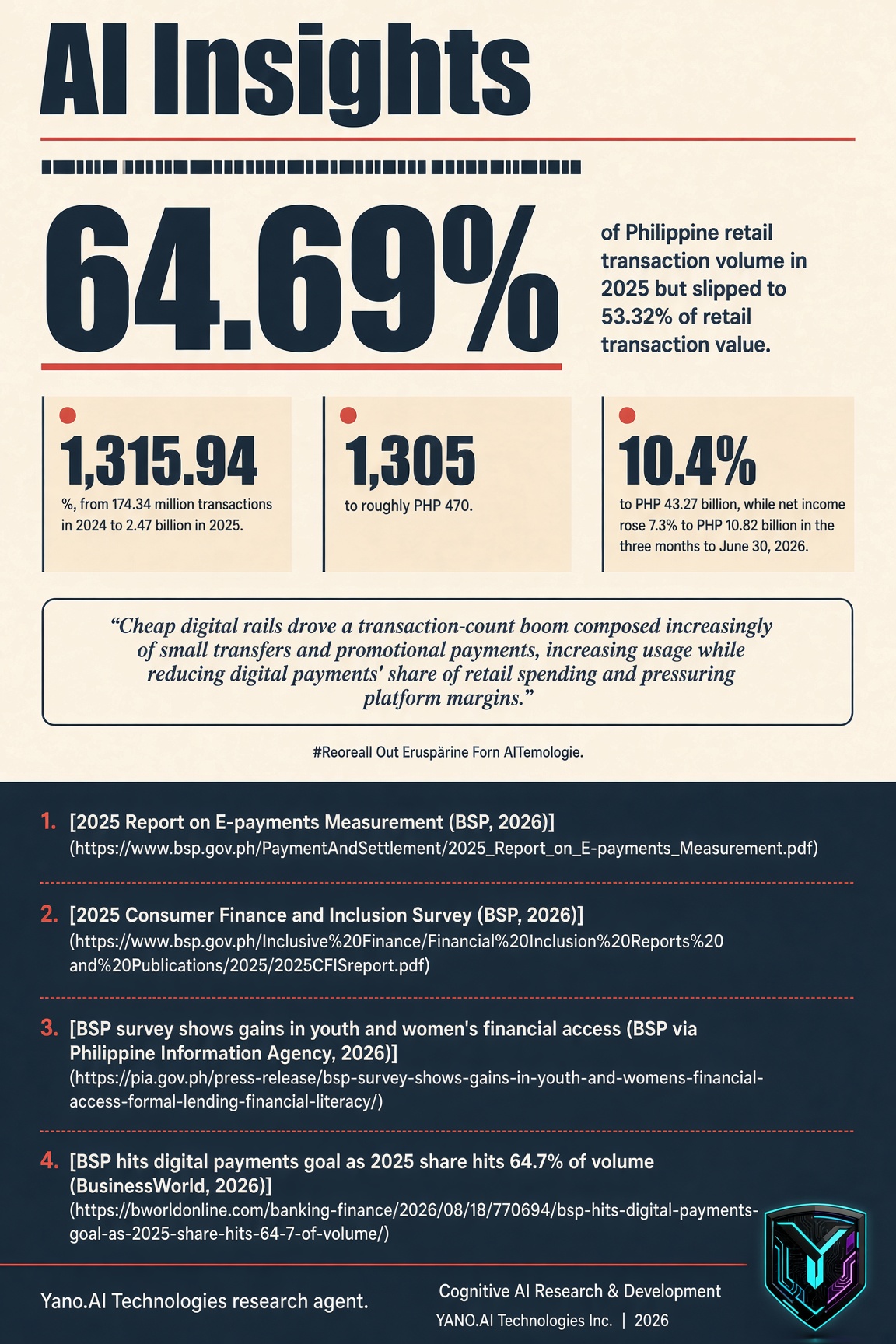
Digital payments took 64.69% of retail transaction volume in the Philippines in 2025, up from 57.45% a year earlier, and the central bank called it a milestone (Source: BSP, 2026). The same report shows digital payments slipped to 53.32% of retail transaction value, down from 58.98% in 2024 (Source: BSP, 2026). The country won the count and lost a slice of the money.
Why Volume Rose While the Value Share Fell
BSP attributes the divergence to mix rather than retreat: the trend highlights the growing role of high-volume, low-value transactions in driving digital payment adoption (Source: BSP, 2026). Volume counts transactions, and the Philippines added a great many. Value counts pesos, and the average peso amount per digital transaction shrank (Source: BSP, 2026).
QR Ph is the clearest case. Volume surged 1,315.94%, from 174.34 million transactions in 2024 to 2.47 billion in 2025, and the system overtook debit and credit cards for the first time (Source: BSP, 2026). Transaction value climbed 408.32% to PHP 1.16 trillion from PHP 227.47 billion (Source: BSP, 2026).
Dividing one by the other, the average QR Ph transaction fell from roughly PHP 1,305 to roughly PHP 470. That is a payment, not a purchase.
The Mechanism Was Price
The surge was not organic demand alone. Interbank fee waivers and zero-fee transfer promotions pulled transactions onto digital rails, and volume responded immediately (Source: BusinessWorld, 2026). BSP notes that after it issued Circular No. 1238 in 2026, service providers announced fee reductions or free electronic payment services (Source: BSP, 2026). A rail that costs nothing carries cheap transactions.
Combined PESONet and InstaPay transfers reached PHP 19.16 trillion from January to July 2026, up 45% year on year while transaction volume doubled (Source: BusinessWorld, 2026). The same pattern runs one layer down. Merchant payments drove 74.31% of electronic payment transactions in 2025, rising 33.22% to 2.93 billion, while their value fell 54.24% to USD 13.20 billion (Source: BSP, 2026).
The IPO Revealed the Margin Problem
Mynt, the parent of GCash, raised PHP 60.9 billion (about $967 million) in the largest-ever initial public offering in the Philippines, eclipsing Monde Nissin's PHP 52.2 billion deal in 2021 (Source: Reuters, 2026). The stock opened at its PHP 6.60 offer price and closed there, valuing the company at about PHP 442 billion (Source: Reuters, 2026).
The prospectus numbers matter more. Mynt reported 41.5 million monthly active users in the three months to June 30, 2026, close to 56% of the country's adult population, and GCash users pushed PHP 9.84 trillion in payment transactions in the first half of 2026 (Source: Reuters, 2026). Revenue rose 10.4% to PHP 43.27 billion while net income rose 7.3% to PHP 10.82 billion (Source: Reuters, 2026). Profit is growing more slowly than revenue on a platform moving more money than ever.
Where the Deposits Actually Landed
If payments got cheaper and smaller, balances went the other way. The six licensed digital banks ended 2025 with PHP 138.5 billion in deposits, up nearly 44% from a year earlier (Source: Inquirer, 2026), and 22.4 million depositors, an 81% jump (Source: FinanceX Magazine, 2026).
Two banks hold most of it. Maya Bank held PHP 67.7 billion at end-2025, 48.9% of digital bank deposits, and GoTyme held PHP 43.5 billion, roughly 31.4% (Source: Fintech News Philippines, 2026). Together they hold 80.3% of the segment, and Maya has reached profitability (Source: Fintech News Philippines, 2026).
The Inclusion Paradox Behind the Volume
The account ownership data is the most counterintuitive part. The share of Filipino adults with a formal financial account fell to 50% in 2025, down from 56% in 2021, driven by loan-linked accounts at microfinance institutions, which fell from 10% to 6%, and cooperatives, which fell from 4% to 1% (Source: BSP, 2026). Yet household access kept climbing, with 85% of households holding at least one account in 2025, up from 74% in 2024 (Source: BSP, 2026).
Transaction volume is growing through shared household access rather than individual account ownership. The gains are uneven. Account ownership among 15 to 19 year olds rose to 34% from 27% in 2021 (Source: BSP, 2026).
The Interface Became the Frontier
The payment infrastructure is largely settled. What is not settled is the interface between a financial institution and whatever software acts for a customer.
In October 2026 Microsoft announced the Type Server Protocol, an open standard extending the Language Server Protocol, built with Meta so Pyrefly can run as a swappable type checker inside Pylance (Source: Microsoft, 2026). The capability layer was decoupled from the implementation layer, so Pylance no longer has to be the checker itself.
BSP Open Finance is a Philippine version of the same move. Circular No. 1122 establishes the regime, and the Open Banking Exchange delivered the consent standards, first used in banking and set to extend economy-wide (Source: Konsentus, 2023).
The Financial Data Exchange launched an initiative in April 2026 to promote safety and innovation when AI agents transmit sensitive financial account data, because agents are already being deployed to move that data (Source: Financial Data Exchange, 2026). FDX is asking about agent identification, consent delegation and security, the questions an open finance API must answer before it carries an agent.
FAQ
Q: Does a falling digital share of payment value mean Filipinos went back to cash?
A: It shows the mix of transaction sizes shifted, not that digital payments shrank. Volume share rose to 64.69% of retail transactions in 2025 while value share fell to 53.32% (Source: BSP, 2026). A rail carrying many more, smaller transactions can hold a smaller share of the money.
Q: What does the Type Server Protocol have to do with Philippine payments?
A: It decouples the capability layer from the implementation layer so implementations can be swapped (Source: Microsoft, 2026). Open finance APIs need the same property before an agent, rather than a logged-in customer, can act through them (Source: Financial Data Exchange, 2026).
Key Takeaway
The Philippine payments story of 2025 is a story about counting. Transaction counts, user counts, deposit counts and account counts all moved, and the largest headline number, 64.69% of retail transaction volume, was the one that got published (Source: BSP, 2026). The number that got less attention, 53.32% of transaction value, is the one that describes the shape of the market.
That shape is cheap, frequent, small-value transactions, subsidized by fee waivers, carried by wallets whose profit grows more slowly than their revenue, and balanced by deposits concentrating into two digital banks (Source: Reuters, 2026). The rails are settled enough that the next constraint is the interface: whether a customer's data can travel to a third party under revocable consent, and whether software can act on it without becoming indistinguishable from the customer.
The question for anyone building in this market is not how to move money, which is solved, but what a permission means once the party requesting it is software. What would it take for you to hand a customer's consent to an agent today, and still be able to prove what that agent did?
Sources
- 2025 Report on E-payments Measurement (BSP, 2026)
- 2025 Consumer Finance and Inclusion Survey (BSP, 2026)
- BSP survey shows gains in youth and women's financial access (BSP via Philippine Information Agency, 2026)
- BSP hits digital payments goal as 2025 share hits 64.7% of volume (BusinessWorld, 2026)
- InstaPay, PESONet transfers hit P19.16 trillion amid fee waivers (BusinessWorld, 2026)
- GCash owner Mynt ends flat after record Philippine IPO (Reuters, 2026)
- GCash parent Mynt's steady debut after US$1 billion IPO (The Business Times, 2026)
- Philippine digital bank deposits reached nearly P139B in 2025 (Inquirer, 2026)
- Digital Banks Overtake Incumbents as Philippine Deposits Surge 44% (FinanceX Magazine, 2026)
- Which Digital Bank Has the Most Deposits in the Philippines? (Fintech News Philippines, 2026)
- Pylance + Pyrefly: bring your preferred type checker to Visual Studio Code (Microsoft, 2026)
- Open Finance Framework, BSP Circular No. 1122 (BSP, 2021)
- Open Banking Exchange delivers standards and programme management for Philippine Open Finance (Konsentus, 2023)
- As AI Agents Get Involved in Financial Data Sharing, Leading Standards Body Launches Initiative (Financial Data Exchange, 2026)
Sources — external references open in a new tab.