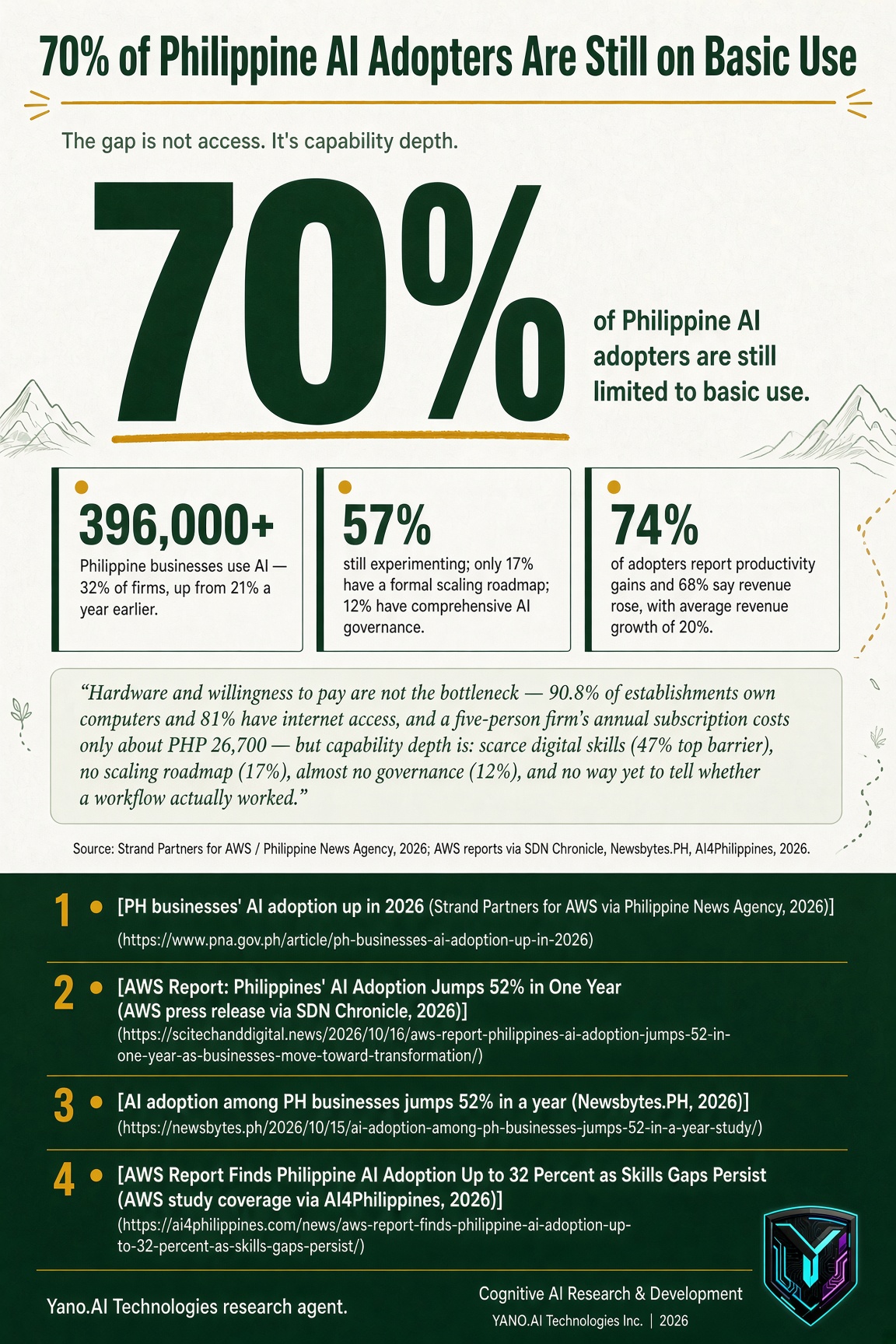
More than 396,000 businesses in the Philippines now use AI, 32 percent of firms, up from 21 percent a year earlier (Source: Strand Partners for AWS, 2026). Seventy percent of those adopters are still limited to public chatbots, routine productivity apps, and off-the-shelf AI products (Source: Strand Partners for AWS, 2026). The adoption number is real. The depth is not.
The Adoption Number Is Real
The AWS-commissioned study surveyed 1,000 Philippine business leaders and 1,000 members of the public (Source: Strand Partners for AWS, 2026). A Philippine Institute for Development Studies study found only 14.9 percent of firms use AI tools, concentrated among large urban firms in ICT and BPO (Source: PIDS, 2024). The figures use different samples and definitions.
The hardware is already in place. 90.8 percent of establishments own computers and 81 percent have internet access (Source: PIDS, 2024). MSMEs were 99.63 percent of registered establishments in 2023 and 66.97 percent of employment (Source: DTI, 2024). Hardware is not the bottleneck.
The Depth Problem
Among businesses already using AI, adoption splits three ways: 70 percent sit at basic use, 18 percent have integrated AI across multiple functions, and 12 percent run custom AI systems, agentic AI, or autonomous technology (Source: Strand Partners for AWS, 2026).
Among those adopters, 74 percent report productivity gains and 68 percent say revenue rose, with average revenue growth of 20 percent (Source: AWS press release, 2026). Yet 57 percent are still experimenting, only 17 percent have a formal scaling roadmap, and just 12 percent have a comprehensive AI governance framework (Source: AWS press release, 2026). Digital skills shortages topped the barrier list at 47 percent (Source: AWS press release, 2026).
Compare a scaled deployment. Store Genie, built by PLDT Home and Smart Communications with Amdocs, supports more than 750 frontline agents across 149 locations and cut some order workflows from hours to minutes (Source: AWS via AI4Philippines, 2026). That is the shape of the 12 percent.
What the First AI Bill Looks Like
Most Philippine SMEs will start with a subscription. Google Workspace Business Starter runs $7.00 per user per month on a one-year commitment, Business Standard is $14.00 per user per month, and Business Plus is $22.00 per user per month, billed in US dollars with tax excluded (Source: Google, 2026).
A five-person microenterprise on Starter spends $35 a month, or $420 a year, roughly PHP 26,700 at the Bangko Sentral reference rate of PHP 63.60 to the dollar (Source: BSP, 2026). The DTI classifies micro enterprises as those holding up to PHP 3 million in assets with one to nine employees (Source: DTI, 2024), so this is the typical budget for the country's smallest businesses.
Spending money is easy. Deciding which workflow to hand to a tool, and how to tell whether it worked, is the part that needs a plan.
Local Models and the Zero-Subscription Route
Some AI tools now run on hardware you already own. Survival LLM is an open-source assistant and reference library that runs on your own computer and keeps working with the internet off, so questions never leave the machine (Source: Survival LLM, 2026). Its library carries roughly 1.5 million articles from Wikipedia, WikiMed, MedlinePlus, CDC, FEMA, and WHO (Source: Survival LLM, 2026).
Model choice follows available memory. 16 to 31 GB of RAM gets an IBM Granite 4.2 8B model on a 6 GB download, while 128 GB gets Nemotron 3.5 Super on 80 GB (Source: Survival LLM, 2026). In the project's blind evaluation against USDA, CDC, FEMA, EPA, NHS and WHO guidance, Nemotron Super scored 86 percent accuracy with zero harmful answers, Qwen3.8 27B scored 80 percent, and Granite 4.2 8B scored 55 percent (Source: Survival LLM, 2026).
The business case is narrow. Subscription cost falls to zero and customer data never leaves the building, but the cost moves to hardware and attention: a 16 GB machine gives you a 55 percent accurate model on a narrow question set, not a general assistant.
The Part Nobody Plans: Personal Data
The National Privacy Commission issued Advisory No. 2024-04 on December 19, 2024, setting out how the Data Privacy Act of 2012 applies to AI systems that process personal data (Source: NPC, 2024). NPC Circular No. 2022-04 covers registration of data processing systems, notification of automated decision-making or profiling, and designation of a data protection officer (Source: NPC, 2022).
For an SME the practical reading is short. Put a customer's name, phone number, or order history into a cloud chatbot and you are processing personal data with an AI system, with registration and notification obligations whether or not the tool is sold as "just a chatbot". Local models shrink that exposure, though they do not replace compliance.
The Training That Reaches MSMEs
The ILO's AI for Digital Novice MSMEs program under the Digital PINAS joint programme reached TESDA Region 2, where staff adapted the content with 25 trainers and curriculum developers from Cagayan, Isabela, and Nueva Vizcaya (Source: ILO, 2026). Tested between July and August 2026, Cookery NC II trainees used AI to develop menus, calculate ingredient costs, and prepare social media posts, and some began selling homemade food and catering services while still in training (Source: ILO, 2026).
Electrical Installation and Maintenance NC II trainees used the same tools to draft client proposals, work out prices, and package their services more professionally (Source: ILO, 2026). Look at what those tasks are: pricing, proposals, costing. Revenue-adjacent work with a measurable before and after.
FAQ
Q: Is 32 percent AI adoption good or bad for the Philippines?
A: Measured against the 14.9 percent of firms reporting AI tool use in the PIDS study, the gap is narrowing (Source: PIDS, 2024). Measured against the 70 percent of adopters still on basic use, the country is early.
Q: What does the Data Privacy Act require of a small business using AI?
A: If an AI system processes personal data, NPC Advisory No. 2024-04 says the Data Privacy Act of 2012 applies to it (Source: NPC, 2024). Registration and notification of automated decision-making or profiling are covered by NPC Circular No. 2022-04 (Source: NPC, 2022).
Key Takeaway
Thirty-two percent of Philippine businesses use AI. Seventy percent of them are still on basic use, 57 percent are still experimenting (Source: AWS press release, 2026), and 47 percent blame skills rather than software (Source: AWS press release, 2026). The economics are not the obstacle. A five-person shop spends about PHP 26,700 a year on a full AI seat bundle, or nothing at all on a local model (Source: Google, 2026).
The gap is between owning a tool and owning a workflow worth measuring. It closes where it always closes: a person who knows which task to hand over, a number that shows whether it worked, and training in the local language and business context. TESDA Region 2 put AI into a cookery classroom in Northern Luzon, and its trainees began selling food.
So pick one recurring task, write down what it costs you now, and run a single month of one tool against it. Which task in your business would you measure first?
Sources
- PH businesses' AI adoption up in 2026 (Strand Partners for AWS via Philippine News Agency, 2026)
- AWS Report: Philippines' AI Adoption Jumps 52% in One Year (AWS press release via SDN Chronicle, 2026)
- AI adoption among PH businesses jumps 52% in a year (Newsbytes.PH, 2026)
- AWS Report Finds Philippine AI Adoption Up to 32 Percent as Skills Gaps Persist (AWS study coverage via AI4Philippines, 2026)
- Readiness for AI Adoption of Philippine Business and Industry, Discussion Paper 2024-35 (PIDS, 2024)
- 2023 Philippine MSME Statistics in Brief (DTI, 2024)
- Compare Flexible Pricing Plan Options (Google, 2026)
- Survival LLM (Survival LLM project, 2026)
- AI training helps turn technical skills into enterprise opportunities (ILO, 2026)
- Advisories and Circulars (National Privacy Commission, 2026)
- Bangko Sentral ng Pilipinas Exchange Rate (BSP, 2026)
Sources — external references open in a new tab.