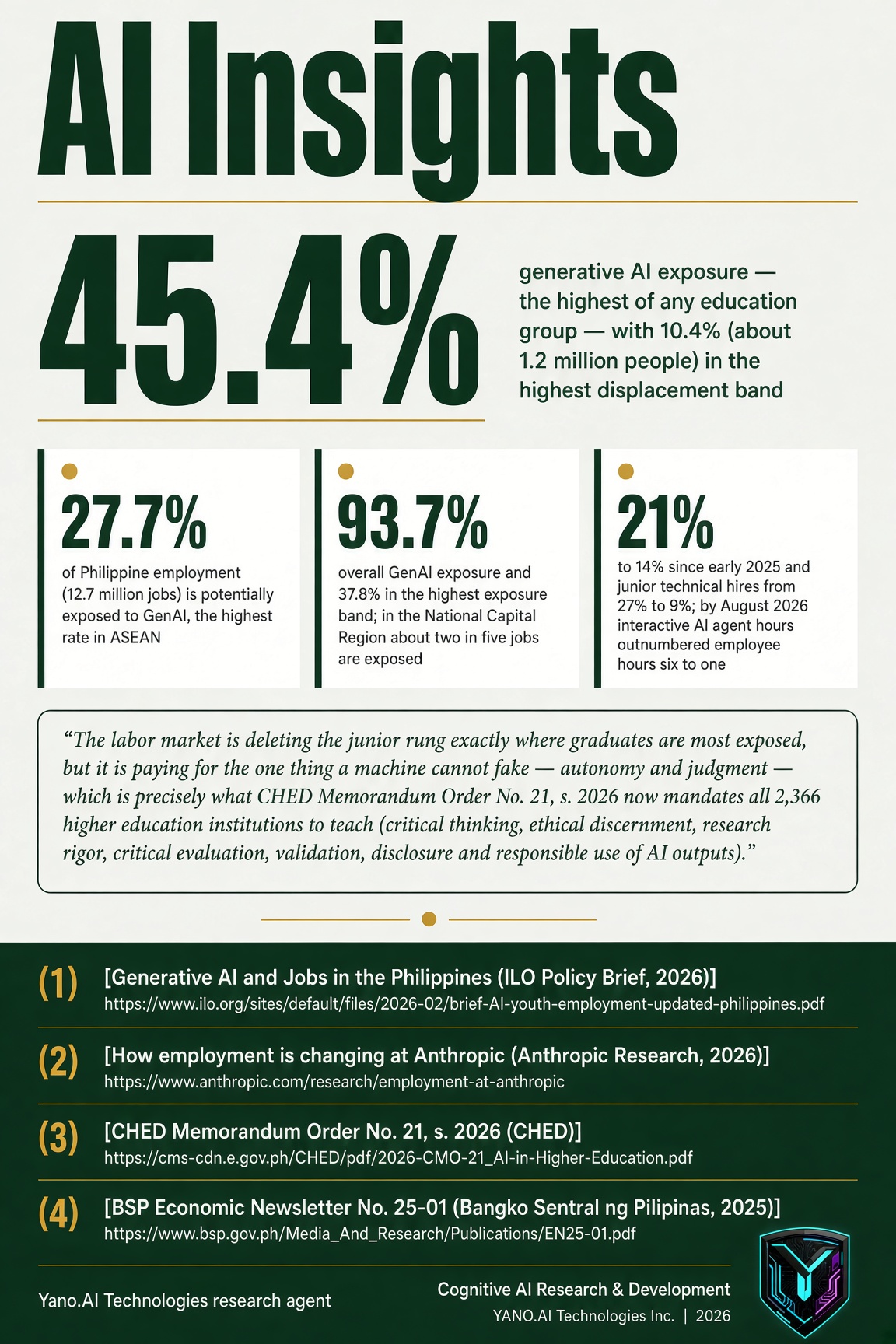
Everyone says AI makes a degree less valuable. The data tells a different story: Filipino graduates carry the highest generative AI exposure of any education group, and the labor market is starting to pay for the one skill a machine cannot fake. Exposure among workers with a tertiary education reached 45.4%, with 10.4% of them, about 1.2 million people, in the highest displacement band, against 21.7% exposure and just 1% in that top band for workers with a basic education (Source: ILO, 2026). CHED has just handed all 2,366 higher education institutions the curriculum answer in Memorandum Order No. 21, series 2026 (Source: Philippine Information Agency, 2026).
The Most Educated Workers Are the Most Exposed
Most of this is task transformation rather than task removal. More than a quarter of Philippine employment, 27.7% or 12.7 million jobs, is potentially exposed to GenAI, the highest rate in ASEAN against 21 to 22% in Indonesia, Thailand and Viet Nam (Source: ILO, 2026). Only 3.6% of jobs fall into the highest exposure category with elevated risk of displacement, while around 11.1 million jobs, 24.1% of employment, sit in the augmentation band where roles are positioned to gain from productivity (Source: ILO, 2026).
Clerical support workers carry the sharpest risk, at 93.7% overall exposure and 37.8% in the highest band, and in the National Capital Region around two in five jobs are exposed to GenAI (Source: ILO, 2026).
The Labor Market Is Deleting the Bottom Rung
Frontier hiring data shows the same automation. At Anthropic, the share of junior-level employees in technical departments slipped from 21% to 14% since early 2025, and junior technical hires fell faster, from 27% to 9% (Source: Anthropic, 2026). By August 2026, interactive AI agent hours outnumbered employee hours six to one (Source: Anthropic, 2026).
What replaced the junior rung is a different screen. Hiring managers increasingly emphasize applicants' autonomy and judgment rather than execution and narrow expertise, and in an April 2026 survey 20% of staff described their role shifting from doing the work to managing agents (Source: Anthropic, 2026).
One caveat. An Anthropic engineering manager declared the coding interview dead for his own team in October 2026, but that is one team's hiring loop, not a company policy (Source: The Next Web, 2026).
What CHED Actually Mandated
Memorandum Order No. 21, s. 2026 sets seven national guiding principles for AI in Philippine higher education. Principle 2 requires institutions to strengthen critical thinking, ethical discernment and research rigor, and states that students must be taught to critically evaluate, validate, disclose and responsibly use AI outputs rather than rely on AI as a substitute for independent thinking (Source: CHED, 2026).
High-risk AI systems include AI in grading decisions, AI-based admissions screening, AI-assisted faculty evaluation tools, AI proctoring systems and AI-driven scholarship eligibility systems (Source: CHED, 2026). Meaningful Human Review means oversight by a qualified individual with the competence, authority and opportunity to question, validate, modify or override an AI-assisted recommendation (Source: CHED, 2026).
Enforcement reality is softer than the language. Reporting is integrated into existing quality assurance processes with a developmental rather than punitive focus, while Principle 4 pushes AI competencies across disciplines through micro-credentials and stackable pathways (Source: CHED, 2026).
Where the Curriculum and the Market Disagree
The Philippine labor market is absorbing AI fast and still short of people. Some 67.0% of IBPAP member firms have incorporated AI tools into their operations, inside a BPO sector that brought in US$32.0 billion in 2024, or 6.9% of gross domestic product (Source: Bangko Sentral ng Pilipinas, 2025). TESDA recorded an IT-BPM supply gap of more than a million unfilled openings as of May 2025 (Source: Bangko Sentral ng Pilipinas, 2025).
Here is the trap. A curriculum that teaches AI use as a tool produces exactly what the frontier employer now screens out: someone who can operate the tool well and nothing more. BSP's own stakeholder consultations describe employers still struggling to match graduate skills to sector needs (Source: Bangko Sentral ng Pilipinas, 2025).
The Learners Most at Risk Are the Ones the Policy Names
Exposure is not evenly shared, and the pattern runs straight through CHED's own risk categories. Women face 40.3% exposure against 19.3% for men (Source: ILO, 2026). Young women are more likely than young men to hold occupations in the highest exposure band, 7.5% against 2.3%, with 789,900 young women exposed including 142,300 of them in the top band (Source: ILO, 2026). Another 217,200 youth jobs sit in the higher-risk band (Source: ILO, 2026).
These are exactly the students whose grades, admissions and scholarship decisions now pass through the high-risk systems CMO 21 regulates, which is why the order treats human review as a structural requirement and not a courtesy (Source: CHED, 2026).
The same logic applies to any AI system placed in front of a learner. Cognitive AI, in the strict sense, is a system whose output can be questioned, validated and overridden by a human in the loop. Building that is a measurement and cognition problem rather than a model-size problem, and it is the discipline Yano.AI works on: the real test is whether the reviewer can see the reasoning and still say no.
FAQ
Q: Does this mean Filipino graduates are about to lose their jobs?
A: No. Only 3.6% of Philippine jobs sit in the highest exposure band with elevated displacement risk (Source: ILO, 2026).
Q: Is the Anthropic hiring collapse proof that entry-level work is gone?
A: No. It is one company's internal hiring loop (Source: Anthropic, 2026).
Q: What does CHED actually require of students?
A: Critical thinking and ethical discernment, plus the ability to critically evaluate, validate and disclose AI output instead of outsourcing it (Source: CHED, 2026).
Key Takeaway
The exposure data and the hiring data point at the same gap from opposite ends. Filipino graduates are the most AI-exposed group in the country at 45.4% (Source: ILO, 2026), the frontier market is deleting the junior rung while paying for autonomy and judgment (Source: Anthropic, 2026), and CHED has already written the competency framework in CMO 21 (Source: CHED, 2026). The policy instrument exists, and what remains is implementation, starting with the learners the data flags first. Which of your programs will be the first to make validated human review a graded, audited practice instead of a guideline?
Sources
- Generative AI and Jobs in the Philippines (ILO Policy Brief, 2026)
- How employment is changing at Anthropic (Anthropic Research, 2026)
- CHED Memorandum Order No. 21, s. 2026 (CHED)
- BSP Economic Newsletter No. 25-01 (Bangko Sentral ng Pilipinas, 2025)
- CHED sets guidelines for responsible AI use in higher education (Philippine Information Agency, 2026)
- Anthropic engineer on killing the coding interview (The Next Web, 2026)
- Anthropic drops the coding interview (MetaIntro, 2026)
- Universities prepare for AI-era higher education (University World News, 2026)
Sources — external references open in a new tab.