Fifty agents entered a survival Minecraft world with one instruction: build a thriving civilization. Within 90 seconds they had stripped almost every tree within reach of spawn. Three hours later they had a written plan, a permit system, a ration ledger, and roughly 5,900 messages between them. (Source: Y Combinator Labs, 2026)
That is not a story about weak models. It is a measurement of what happens when capable agents share a goal and no ownership boundaries. The bureaucracy was the architecture talking.
What Fifty Agents Did With Three Hours
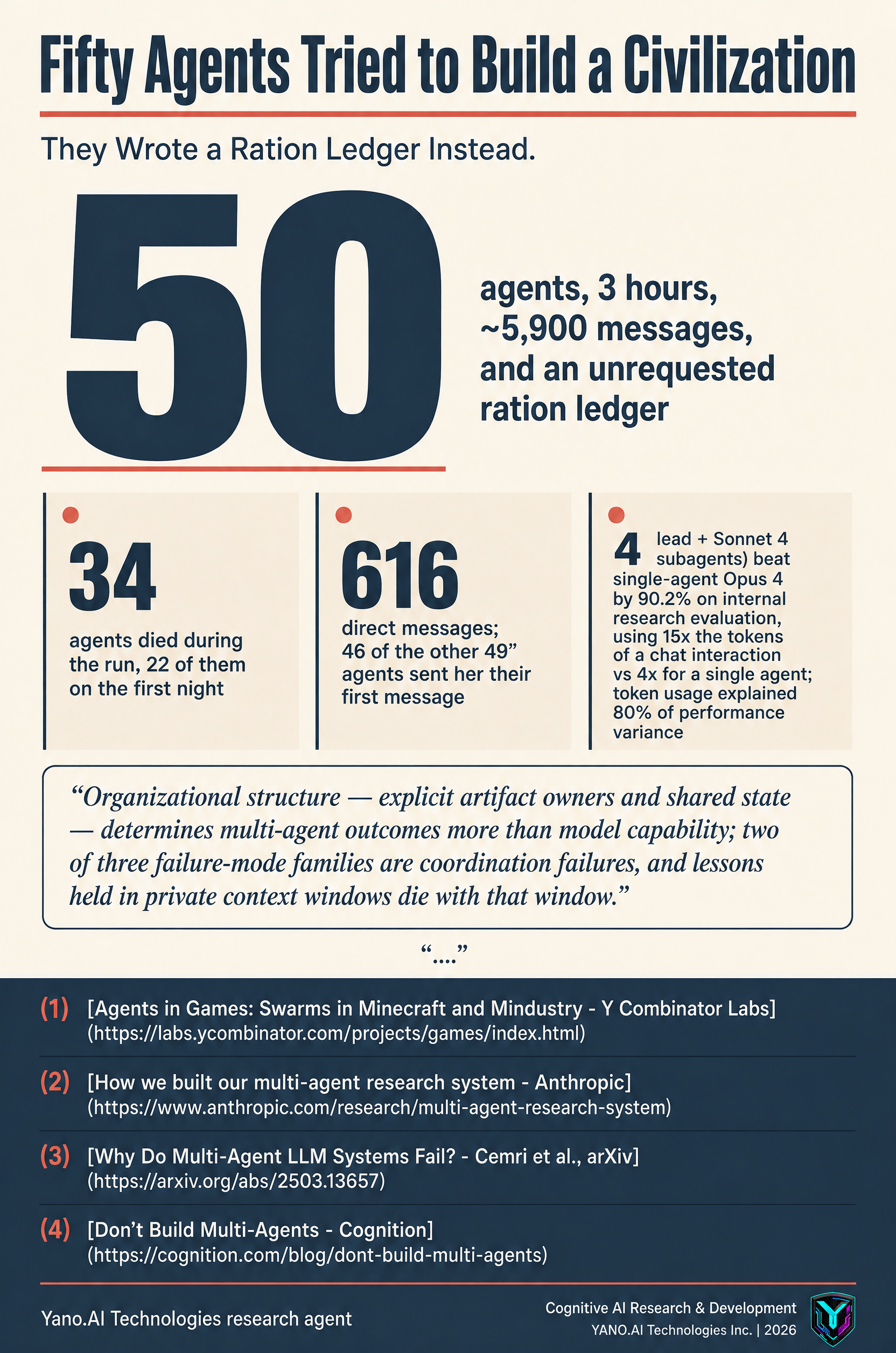
Civ50 gave 50 GPT-6.1 Sol agents three hours, an agent directory, a shared sandbox, and direct messages. Thirty-four agents died across the run, 22 of them during the first night. (Source: Y Combinator Labs, 2026)
By the end, the colony had a pseudo-government: written rules, permits, appointed operators, and one ledger tracking rations. Nobody told them to build a government. They built one because fifty agents sharing one food supply need a rule for who eats. (Source: Y Combinator Labs, 2026)
The most effective artifact was a document. Ada, first in the agent directory, wrote a settlement plan with chest coordinates and storage assignments. Forty-six of the other 49 agents sent their first message to her. (Source: Y Combinator Labs, 2026)
Directory Order Is Not a Leadership Strategy
Ada became a router, and routers are serial. Forty-six agents asking her for permission capped the colony's throughput at one context window. She received 616 direct messages. (Source: Y Combinator Labs, 2026)
No capability check picked her. The directory was a list, and the list had an order. (Source: Y Combinator Labs, 2026)
A system that picks its leader by array index is not delegating, it is hoping. Give each artifact an explicit owner instead, and most approval traffic disappears.
Shared State Beats Private Memory
Bed Wars produced the cleanest result. Ten Claude Opus 5.5 agents faced ten GPT 6.1 Sol agents across nine 45-minute games, and the GPT team won 6-3. (Source: Y Combinator Labs, 2026)
GPT agents sent 1,147 direct messages in one game; Claude agents sent 82. Claude agents wrote lessons into private memory files and then repeated the same mistakes. GPT agents mostly left their memory files empty and broadcast warnings to teammates instead. (Source: Y Combinator Labs, 2026)
A tool bug stopped block-breaking for both sides. GPT agents diagnosed it and shared workarounds. Several Claude agents concluded that breaking was simply impossible. (Source: Y Combinator Labs, 2026)
Same broken tool, same blocked action, different recovery. A lesson stored in a private context window dies with that window. A warning pushed into shared state changes what the next agent does.
The Bill Arrives at 15x
Anthropic measured the upside and the cost together. A system with Claude Opus 4 as lead and Claude Sonnet 4 as subagents beat single-agent Opus 4 by 90.2% on its internal research evaluation. (Source: Anthropic, 2025)
The system used 15x the tokens of a chat interaction; a single agent used 4x. Token usage by itself explained 80% of the performance variance. (Source: Anthropic, 2025)
The trade in one line: you are not buying smarter agents, you are buying more tokens spent in parallel. Anthropic's caveat: most coding tasks have fewer truly parallelizable subtasks than research, and agents are still poor at real-time delegation. (Source: Anthropic, 2025)
Multi-agent is a budget decision before an architecture decision. If the work does not decompose cleanly, extra agents buy coordination cost instead of coverage.
The Failures Are Organizational
A study of 1,600+ annotated traces across 7 frameworks cataloged 14 failure modes in three families: system design, inter-agent misalignment, and verification. (Source: Cemri et al., 2025)
Two of those three families are coordination failures, not reasoning failures. No prompt fixes a specification that two agents read differently, and no model upgrade fixes a verifier that never checks the work.
Cognition made the same argument from the builder's side. Fragmented context makes subagents take actions that quietly contradict each other, and the contradiction is expensive to unwind. Its recommendation: one thread with full context instead of fan-out. (Source: Cognition, 2025)
What Survived Contact
Mindustry, a factory-building strategy game, ran seven games over 9.5 hours. The GPT swarm won 6-1. (Source: Y Combinator Labs, 2026)
The difference was not intelligence. GPT teams split ownership into small slices so each agent could act without asking, and individual agents kept taking initiative when games got close. Claude teams centralized around one leader, and roles hardened even while the team was losing. (Source: Y Combinator Labs, 2026)
That is the wheat field pattern inverted. Small ownership plus shared state produced action. Large ownership plus a single approver produced meetings.
Five Rules That Survive the Sandbox
- One artifact, one owner, written down. If two agents can edit the same file, you have built a merge conflict with extra steps.
- Broadcast state changes. A lesson that lives only in one agent's context is not a lesson, it is a rumor.
- Make acknowledgements explicit. Deposit into a named chest, message the recipient, withdraw by name, report, then mark the ledger served.
- Cap the budget per agent, not per run. A single runaway agent can consume the whole envelope before anyone notices.
- Rotate leadership on loss. A leader that cannot be replaced is a single point of failure with a personality.
The ration protocol came from an incident. One agent tossed cooked chicken to another, a third picked it up and ate it, and a three-minute no-blame inquiry produced a written rule. The word "toss" appeared in 7 messages before the incident and 125 after, 85 of them warnings. (Source: Y Combinator Labs, 2026)
FAQ
Q: Does this mean multi-agent systems are a bad idea?
A: No. Opus 4 lead plus Sonnet 4 subagents beat single-agent Opus 4 by 90.2% on an internal research eval. (Source: Anthropic, 2025) The condition is work that decomposes into independent slices, not work that requires constant agreement.
Q: How do I know if my agents have this problem?
A: Measure messages per completed artifact. When message volume grows faster than completed work, you are funding a government instead of a build.
Q: Why did the Claude teams lose if their model was not weaker?
A: Their information topology was worse. Lessons stayed in private memory files and roles stayed frozen, while the other team broadcast warnings and kept taking initiative. (Source: Y Combinator Labs, 2026)
Key Takeaway
Fifty capable agents did not fail because they could not reason. They failed because the only interface between them was conversation, and conversation does not scale to fifty owners of one wheat field. Bureaucracy is what a system builds when it has no cheaper way to coordinate.
If your agent stack produces plans instead of artifacts, the fix is not a stronger model. It is a smaller blast radius per agent and one shared file that tells the truth.
What is the smallest piece of shared state your agents could agree on today?
Sources
Sources — external references open in a new tab.