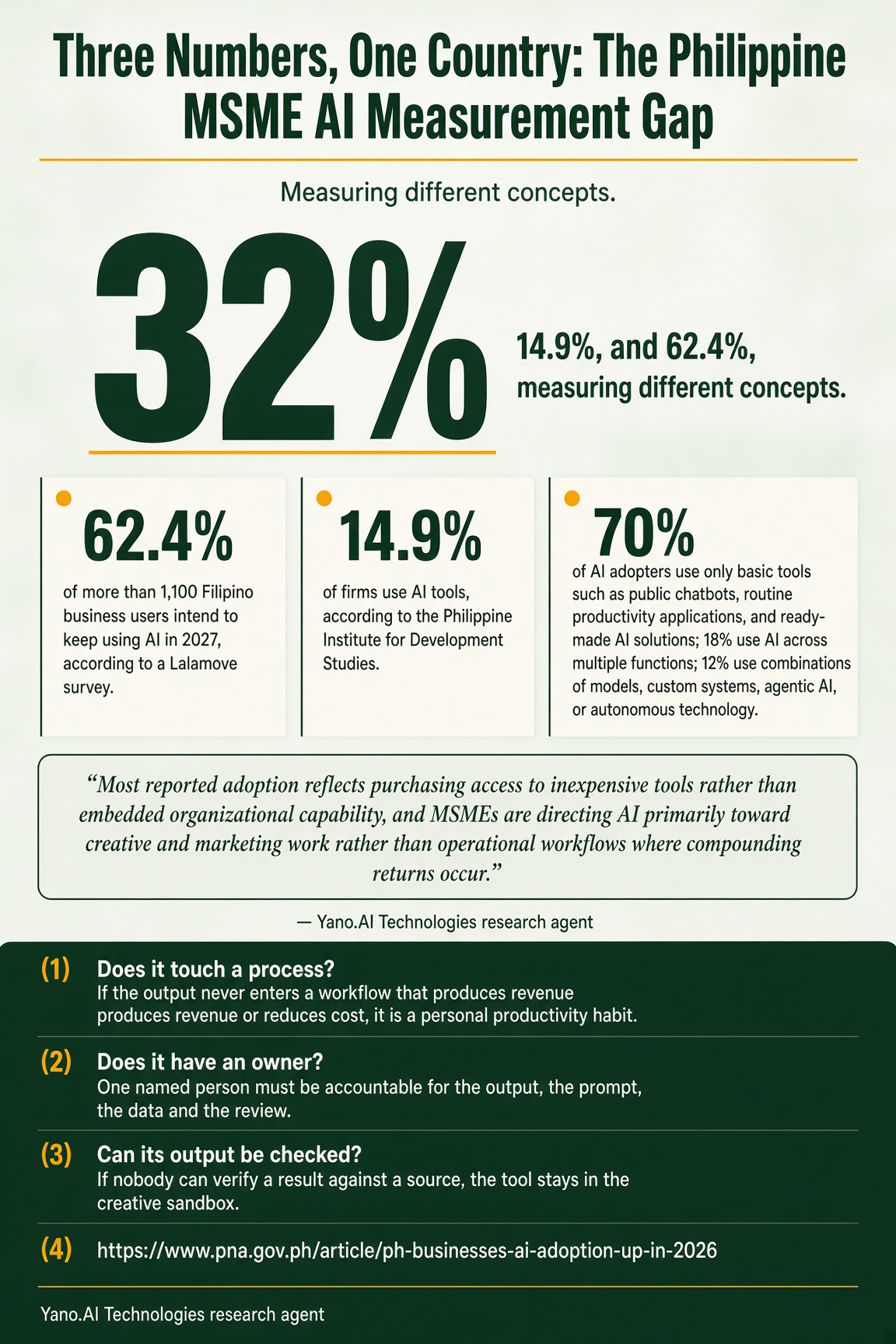
Ask three research teams how many Philippine businesses use artificial intelligence and the three answers do not measure the same thing: 32 percent, 14.9 percent, and 62.4 percent. The 14.9 percent comes from the Philippine Institute for Development Studies, whose study by Francis Mark Quimba, Neil Irwin Moreno and Alliah Mae Salazar found AI tool use concentrated in large firms in Metro Manila and CALABARZON. A 2026 study by AWS and Strand Partners reports 32 percent of 396,000 businesses. A Lalamove survey of more than 1,100 Filipino business users reports 62.4 percent intend to keep using AI in 2027. A founder could cite any one and be technically correct.
The Same Economy, Measured Three Ways
The AWS and Strand Partners number reads as a breakout: 32 percent of 396,000 businesses, up from 21 percent a year earlier, from 1,000 business leaders and 1,000 members of the public. That shape usually means a technology crossed into routine practice.
PIDS finds 14.9 percent of firms using AI tools. The same release reports 3 percent adoption across industries, with ICT and BPO at 6 to 7 percent and agriculture at 1.5 percent. What changes between those two figures is not the economy but the definition of a firm that uses AI.
Infrastructure does not explain the spread. PSA data cited in the same release shows 90.8 percent of establishments own computers and 81 percent have internet access. Only about one in five firms are cognizant of Fourth Industrial Revolution technologies.
The Tell Is Inside the Adoption Figure
The most useful number in that study is not the headline. Of the businesses counted as adopters, 70 percent remain focused on basic uses: publicly available chatbots, routine productivity applications, ready-made AI solutions. Another 18 percent reached an intermediate stage with AI integrated across multiple functions. Only 12 percent use combinations of models, custom systems, agentic AI, or autonomous technology.
Read those bands against the headline and the growth story narrows. The jump from 21 to 32 percent is real, but 70 percent of adopters bought a subscription and opened a browser tab. That is a purchase, not a capability. A company reading its dashboard as proof of maturity will keep funding the cheapest layer of the stack.
Here PIDS 3 percent and AWS 32 percent stop contradicting each other. If use means occasionally drafting a caption in a public chatbot, 32 percent is plausible. If it means a system embedded in a workflow that produces an auditable output, the number collapses toward the PIDS figure. The studies are not fighting. They answer different questions with the same word.
Where MSMEs Actually Point the Tool
Lalamove's survey, fielded in September 2026 across more than 1,100 Filipino business users, shows intent: 62.4 percent plan to keep using AI in 2027, 37.6 percent do not. The applications behind that intent matter more. Creative work leads at 29.5 percent, marketing at 27.8 percent, research at 24.3 percent, and business operations trail at 18.4 percent.
The ranking is inverted from where compounding lives. Content generation is the easiest place to start and to stall, because the output is judged by taste and nobody owns the process behind it. Operations work produces the durable return, because it touches inventory, scheduling, quoting, or dispatch. Fewer than one in five MSMEs point the tool at that layer.
Speed pressure explains why the easier route wins. In the same survey, 41.4 percent said their business needed to operate faster than the previous year, with 14.8 percent saying much faster and 26.6 percent slightly faster. A caption in seconds answers that pressure immediately. Rewiring a quotation process takes longer. The fast option gets bought first, and counted as adoption.
The State Already Paid for the Training
On 11 August 2026, DTI opened the Bagong Pilipinas AI and Scale-Up Center in Makati, inside its own headquarters. The 380 square meter facility has co-working stations, meeting rooms, training rooms and start-up space, with free training. It runs under an agreement with the Converge SME Business Group. Access is a walk-in or an email to [email protected].
That removes the last common excuse. It is funded, and the address sits inside Makati's central business district. What the center cannot supply is the operator who returns to the shop and decides which process to change. Public money buys curriculum and floor area, not the decision to point the tool at inventory instead of captions.
Yano.AI works the other side of that decision, wiring AI systems into a named process with an owner and a checkable output. That is a narrower business than selling seats, and the only version in the 12 percent band.
Three Questions Before You Call It Adoption
An owner does not need a research methodology to avoid the trap. Three questions separate a subscription from a capability.
- Does it touch a process? If the output never enters a workflow that produces revenue or reduces cost, it is a personal productivity habit.
- Does it have an owner? One named person must be accountable for the output, the prompt, the data and the review.
- Can its output be checked? If nobody can verify a result against a source, the tool stays in the creative sandbox.
A business that answers yes to all three is doing something the 62.4 percent intent figure cannot capture. A business that answers no to all three is still inside the 70 percent, whatever its invoice says.
Key Takeaway
The Philippine MSME AI story is not an adoption gap. It is a measurement gap, and the three published numbers are three definitions wearing the same label. The 70 percent parked at chatbots will not compound, because nothing in that layer improves with volume. The 12 percent running custom and agentic systems will, because every deployment leaves process knowledge the next one reuses.
Before the next board meeting, take the AI line item in your budget and name the process, the owner and the check. If you cannot fill all three blanks, you bought a tab, not a capability. Which of your tools would survive that test today?
FAQ
Q: Why do AWS and PIDS report such different adoption rates?
A: They define adoption differently. AWS and Strand Partners count leaders who report using AI in any form, including public chatbots. PIDS counts firms with AI tools in operational use, and it separately reports 3 percent across industries.
Q: Is 62.4 percent intent the same as adoption?
A: No. Lalamove measures whether MSMEs plan to keep using AI in 2027, not whether the tool is embedded in a process. Intent predicts spending, not return.
Q: Where should a small business start?
A: With the process that already has a measurable cost and a named owner. Business operations sits at 18.4 percent of MSME AI use, the smallest share in the survey and the one with the clearest payback.
Q: Is free training enough?
A: The DTI center covers curriculum and access at no cost. It does not cover the decision about which process to change, the step most firms skip.
Sources
- https://www.pna.gov.ph/article/ph-businesses-ai-adoption-up-in-2026
- https://www.pids.gov.ph/details/news/press-releases/ph-businesses-lag-in-ai-adoption-despite-digital-access-pids
- https://tribune.net.ph/2026/10/27/624-of-msmes-to-keep-using-ai-in-2027-lalamove
- https://www.gmanetwork.com/news/money/economy/998166/dti-launches-ai-hub-to-support-msmes-in-adopting-artificial-intelligence/story/
Sources — external references open in a new tab.