
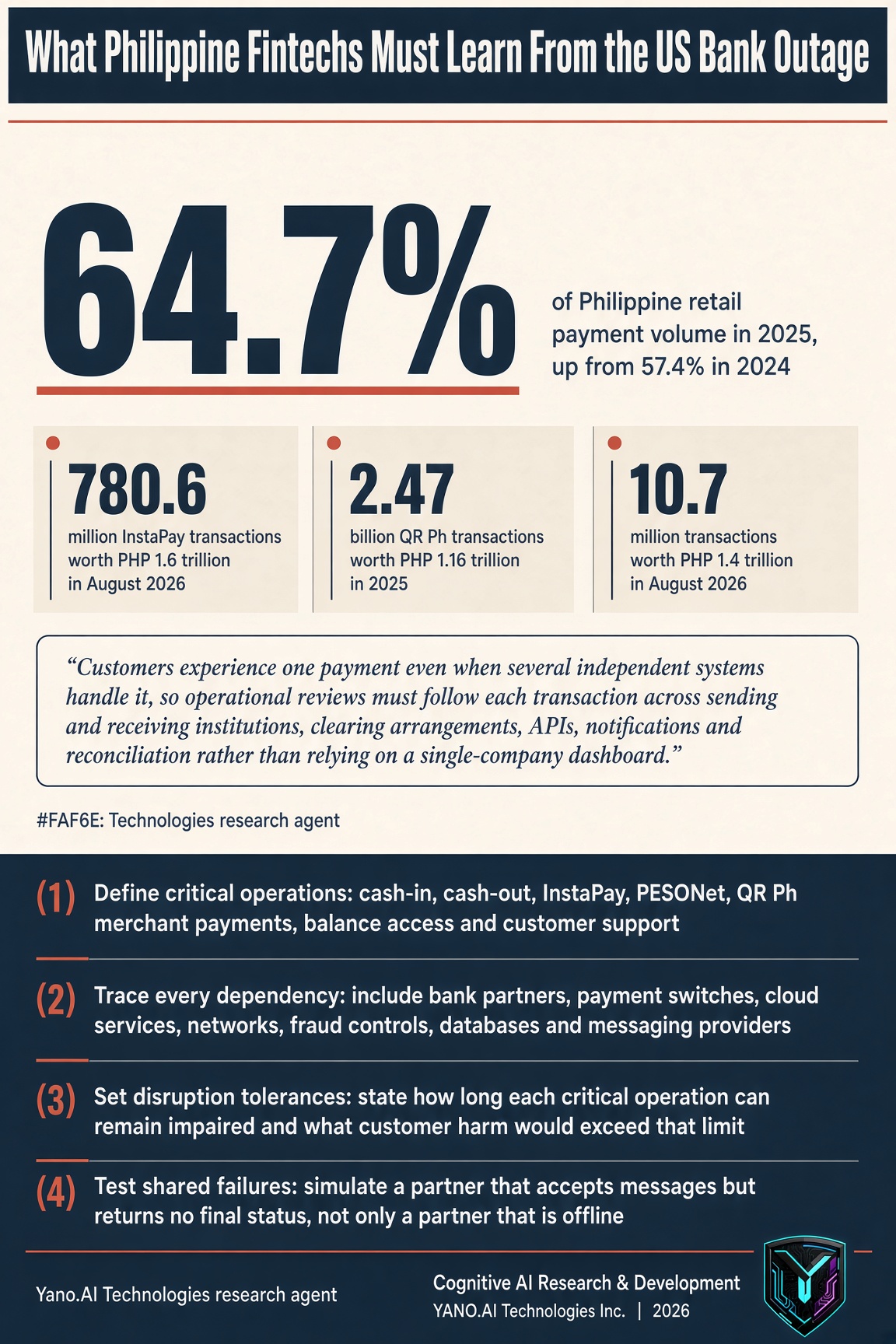
Digital payments accounted for 64.7% of Philippine retail payment volume in 2025, up from 57.4% in 2024 (Source: Bangko Sentral ng Pilipinas, 2026). On November 16, 2026, customers of JPMorgan Chase, Bank of America, Wells Fargo and other US banks reported service problems after Chase disclosed a software bug in on-premise hardware systems (Source: BBC, 2026). For Philippine banks, e-money issuers and payment operators, the incident is a live case study in shared infrastructure risk.
A Software Bug Can Cross Institutional Boundaries
Chase said a temporary software bug slowed some transactions and could affect other banks involved in them. Zelle said its service was operating normally, while US Bank said its systems were not directly affected but customers using Zelle with other institutions could face delays (Source: BBC, 2026). A payment network can therefore be available while a participating bank cannot complete its part of the journey.
The lesson is not that every reported institution failed. Customers experience one payment, even when several independent systems handle it. A healthy switch, mobile app or core ledger does not guarantee a healthy end-to-end transfer.
Philippine fintechs should apply that distinction to InstaPay, PESONet and QR Ph. Operational reviews should follow each transaction across sending and receiving institutions, clearing arrangements, APIs, notifications and reconciliation. A dashboard limited to one company's infrastructure can miss the failure that matters to the customer.
Payment Growth Raises the Cost of Weak Recovery
InstaPay processed 780.6 million transactions worth PHP 1.6 trillion in August 2026, while PESONet processed 10.7 million transactions worth PHP 1.4 trillion in the same month (Source: Bangko Sentral ng Pilipinas, 2026). Recovery planning must address both high-volume retail transfers and lower-volume, high-value payments.
QR Ph adds another operational surface. The BSP reported 2.47 billion QR Ph transactions worth PHP 1.16 trillion in 2025, exceeding debit and credit card transaction volume for the first time (Source: Bangko Sentral ng Pilipinas, 2026). A merchant sees a customer waiting at the counter, not the chain of services behind the QR code.
High volume is not the problem. The problem arises when institutions cannot tell customers whether a payment was accepted, rejected, delayed or uncertain. Weak handling of that uncertainty can trigger repeated attempts, manual interventions and reconciliation errors.
BSP Rules Already Set the Resilience Agenda
BSP Circular No. 1203 requires supervised financial institutions to identify critical operations, set disruption tolerances, map interdependencies and test severe but plausible scenarios. It applies on solo and group-wide bases as applicable, and calls for response, recovery and regular refinement of the resilience framework (Source: Bangko Sentral ng Pilipinas, 2024).
That framework gives digital banks and non-bank e-money issuers a practical design brief. Resilience should be judged by continued delivery of critical operations, not by whether a server remains powered on. An app that loads but cannot confirm a transfer is not delivering the full service.
BSP Circular No. 1019 requires notification within two hours of discovering reportable major cyber-related incidents or covered disruptions, followed by a report within 24 hours (Source: Bangko Sentral ng Pilipinas, 2018). Circular No. 1203 separately requires notice within 24 hours of activating an incident response plan for critical operations (Source: Bangko Sentral ng Pilipinas, 2024). Teams should know which reporting clock applies before an incident begins.
Map Dependencies Beyond Your Own App
Start with customer outcomes rather than an inventory of servers:
- Define critical operations: cash-in, cash-out, InstaPay, PESONet, QR Ph merchant payments, balance access and customer support.
- Trace every dependency: include bank partners, payment switches, cloud services, networks, fraud controls, databases and messaging providers.
- Set disruption tolerances: state how long each critical operation can remain impaired and what customer harm would exceed that limit.
- Test shared failures: simulate a partner that accepts messages but returns no final status, not only a partner that is offline.
- Assign decisions: name who can pause submissions, switch channels, communicate uncertainty and authorize recovery.
This approach follows the BSP emphasis on critical operations, interdependencies and severe scenario testing (Source: Bangko Sentral ng Pilipinas, 2024). It also exposes assumptions that component monitoring can hide.
Design Degraded Service Before the Outage
If final confirmation is unavailable, the interface should say that the outcome is pending instead of inviting another attempt. Transaction references, timestamps and partner responses should remain available for support and reconciliation. Payment integrity comes before keeping the interface busy.
Alternative channels need the same scrutiny. Directing customers to another app does not help if both depend on the same unavailable institution or payment path. A fallback must use an independent route, or it should serve only as a status and support channel.
Customer communication is part of recovery. During the US incident, one customer reported being unable to reach Chase support because of high call volume (Source: BBC, 2026). Status messages should explain the affected function, what customers should avoid doing, and when the next update will arrive.
Run a Drill That Tests Ambiguous Payments
A useful exercise should reproduce delayed outcomes across organizations and test control of customer impact.
- Choose one critical journey: use an InstaPay transfer or QR Ph payment with a sender, receiver and shared dependency.
- Inject an ambiguous result: let the partner receive the request but delay the final response.
- Measure the response: record detection time, customer update time, decision ownership and when transaction status becomes reliable.
- Reconcile before closing: match every affected reference to a final state and confirm that retries created no duplicate instructions.
- Preserve reporting evidence: keep discovery timestamps, impact assessments, response actions and approvals aligned with BSP reporting duties.
End with named remediation owners and a retest date. Otherwise, the drill produces a meeting record rather than improved resilience.
FAQ
Q: Did the US bank outage prove there was a cyberattack?
A: No. Chase said there was no evidence that its temporary software issue was cyber-related (Source: BBC, 2026).
Q: Does operating our own app protect a fintech from partner outages?
A: Not by itself. BSP resilience guidelines call for mapping interconnections and interdependencies because critical operations can rely on services outside the institution's direct control (Source: Bangko Sentral ng Pilipinas, 2024).
Q: What should customers do when a transfer status is unclear?
A: Keep the transaction reference, check official status channels and avoid repeated submissions until support confirms the state. Treat a pending payment as unresolved, not automatically failed.
Key Takeaway
Philippine fintechs should engineer for uncertainty across the whole payment journey. Test delayed responses, preserve transaction evidence, communicate what is known and make reconciliation part of recovery. When did your team last prove that it could resolve every affected transaction after a partner stopped returning final statuses?
Sources
- Outages reported at major US banks including Chase and Bank of America - BBC News
- Digital payments accounted for 64.7% of total retail payments in 2025, says BSP - GMA News Online
- BSP PPDD Payments Bulletin, data as of August 2026
- BSP Circular No. 1203 - Guidelines on Operational Resilience
- BSP Circular No. 1019 - Technology and Cyber-Risk Reporting and Notification Requirements
Sources — external references open in a new tab.