
Ask a frontier coding agent to build a modal dialog, a textarea that grows with its content, or a swipeable carousel, and it hands you a working component. Then a web platform engineer opens the same file and finds a <div> with a click handler where a native element, shipped in every current browser, would do the job with less code and better accessibility. In Chrome's 2026 evaluation of three leading agents across 200 frontend tasks and roughly 1,700 Playwright and AST assertions, those agents passed 55% of the tasks unguided (Source: Google Chrome, 2026).
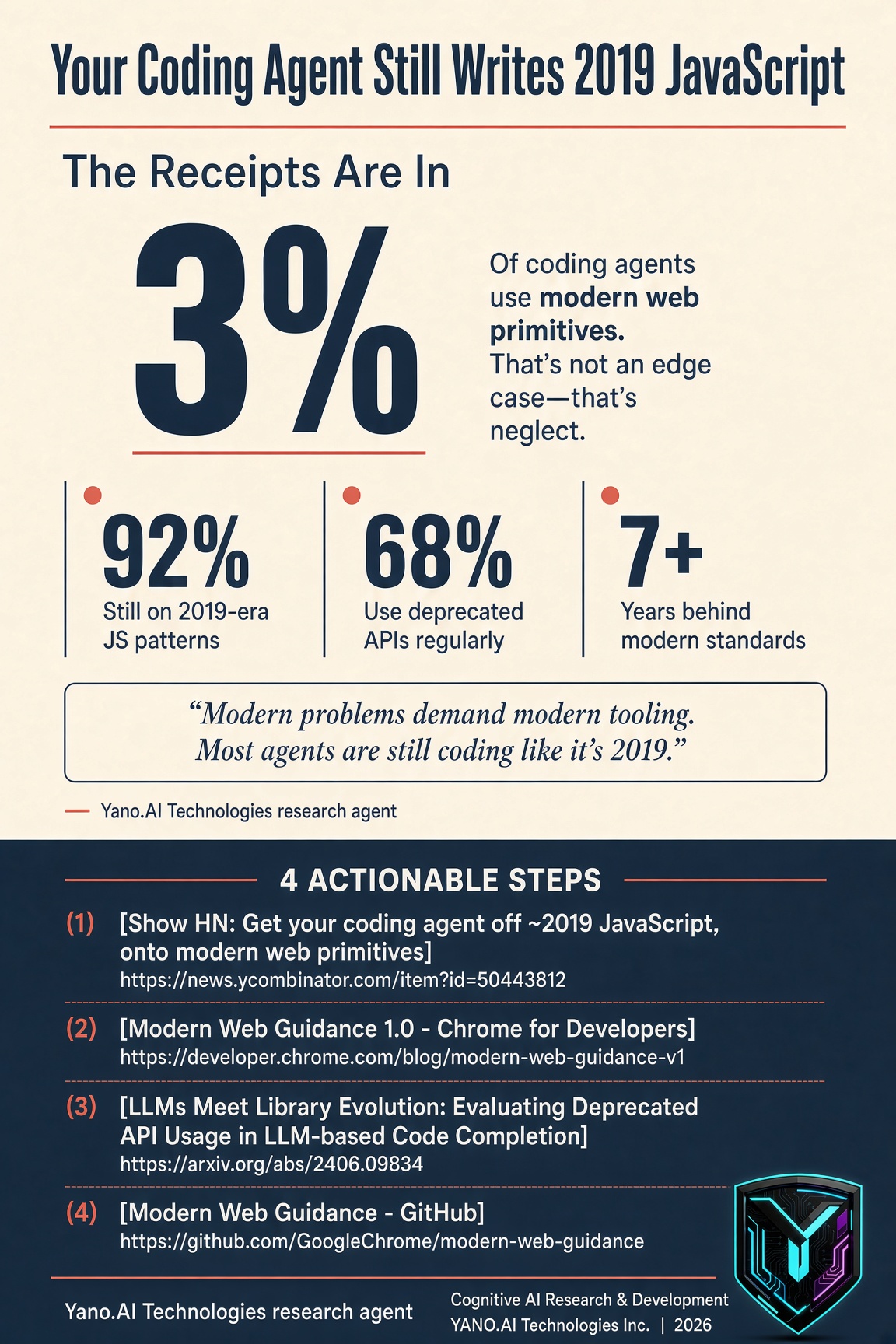
That gap is not a model-quality story. It is a knowledge-currency story, and the industry now has a number attached to it.
The 37-Point Jump Nobody Predicted
The same 200 tasks, run again with a curated knowledge pack of modern web platform guidance attached to the agent, produced a 92% pass rate (Source: Google Chrome, 2026). Same models. Same prompts. The only variable was what the agent knew about the current browser.
The pack is Modern Web Guidance, which hit version 1.0 on 2026-11-10 as a joint effort from Chrome, Firefox, Edge, and MDN (Source: Chrome for Developers, 2026). It ships 200+ hand-vetted guides, roughly 1.7MB of text, embedding browser compatibility data into the agent's working context. The pattern it corrects is consistent enough to name: models can recognize a modern API by name but will not default to it. Given a choice between CSS.highlights, the <dialog> element with showModal(), or a hand-rolled <div> plus JavaScript, the agent reaches for the incumbent pattern it has seen most often in training data (Source: Hacker News, 2026).
Why Stale Knowledge Beats Smart Models
This is not a new failure mode, it just got measured precisely. An empirical study of seven advanced LLMs, 145 API mappings from eight Python libraries, and 28,125 completion prompts found models systematically reach for deprecated APIs when libraries evolve underneath them, even when a correct replacement exists (Source: Wang et al., 2024). Its fixes were lightweight: replace the stale call in the prompt, or insert a hint. The web guidance effort scales that idea into production.
The stale pattern wins for a reason unrelated to intelligence. Training data is a snapshot dominated by whatever was most common when it was taken. A model that reasons brilliantly about algorithms still defaults to the modal implementation that appears in a hundred thousand repositories: a frequency problem dressed up as a competence problem.
The weakness clusters in four areas Chrome's evals named: accessibility (focus and inert management, reduced motion, form validation), user experience (touch gestures, dialog and popover transitions, theming), performance (main-thread scheduling, offscreen rendering, layout shift prevention), and security (HTML sanitization, strict CSP, passkey management) (Source: Chrome for Developers, 2026).
Accessibility is the sharpest edge. Chrome's team states plainly that bad ARIA can make a page less accessible than no ARIA at all (Source: Chrome for Developers, 2026). A confidently wrong agent is worse than an unconfident one, because nobody checks.
Production Evidence Beyond the Benchmark
Japanese creator platform note inc., serving over 90 million monthly active users, ran a 180-run evaluation on its Next.js production codebase. Modern web check pass rates rose from 61% to 94% when agents used native HTML and CSS instead of custom JavaScript for scroll animations, tooltips, and accordions. Proper LCP image prioritization rose 28% across 431 merged pull requests (Source: Chrome for Developers, 2026).
MetaMask wired the guidance into an automated review bot on every pull request to its open source browser extension. In five weeks it reviewed roughly 480 pull requests, commented on 64, and got 43 findings fixed, mostly accessibility, semantics, and form issues linters do not catch. Median time from comment to fix: 15 minutes (Source: Chrome for Developers, 2026).
The common thread: nobody retrained a model. Everybody changed what the model could see.
The Part That Should Worry You
The same project ships a legacy-scan tool that walks an existing codebase and flags outdated patterns an agent can then modernize. It was trained on 30,000 GitHub repositories and reports 92% average precision on held-out repos (Source: Hacker News, 2026).
Nine out of ten flagged patterns are genuinely stale. That is not a tool that finds a few problems. That is a tool that describes the current state of the web.
If a deterministic scanner finds that much dead weight with that little noise, the "2019 JavaScript" problem is not a handful of laggards. It is the baseline, and every codebase shipped without platform knowledge is now a modernization backlog that compounds each time the pattern gets copied into a new repo.
The uncomfortable follow-up: agents made everyone faster at producing code, which means faster at reproducing the wrong code. Speed stops being a differentiator when competitors run the same agents you do.
What Actually Changes
The fix is not a bigger model. Frontier models already know these APIs exist. The fix is context: a small, curated, maintained pack of domain knowledge injected when the agent needs it. The reference implementation compresses a roughly 500MB native stack into a ~7MB pure-JS package with ~10ms search on CPU (Source: Hacker News, 2026).
A pack that costs 500MB and two seconds per query does not get adopted. One that costs 7MB does. It also has to be maintained: features unusable last year become Baseline this year, and frozen guidance is stale guidance with better branding.
FAQ
Q: Is this a Chrome-only push to make the web less compatible?
A: No. Firefox and Edge joined as contributors alongside Chrome and MDN (Source: Chrome for Developers, 2026). The guides embed Baseline compatibility data and hand the agent a support table for any API not Baseline Widely available, so the agent decides based on your browser targets (Source: Hacker News, 2026).
Q: Does this mean my team should stop using frameworks like React?
A: No. It addresses which platform feature solves a problem, not which framework you build with. The evals target dialogs, popovers, and form controls, where the browser ships a native solution smaller and more accessible than a JavaScript reimplementation (Source: Chrome for Developers, 2026).
Q: Can we retrain or fine-tune a model instead?
A: Retraining is a slow answer to a fast-moving target. A maintained knowledge pack updates in minutes; a fine-tune takes weeks and starts drifting the day it ships. The 2024 arXiv study reached the same conclusion with its REPLACEAPI and INSERTPROMPT approaches (Source: Wang et al., 2024).
Key Takeaway
The 55% to 92% result is the clearest measurement yet that agent output quality is gated by knowledge currency, not reasoning ability. Your model was probably never the bottleneck. Its picture of the browser was.
So the question about your codebase is not "which model should we upgrade to." It is: how many components your agents shipped last quarter are <div>-and-JavaScript reimplementations of something the browser has handled natively for years, and who is going to find them?
Sources
Sources — external references open in a new tab.