Your AI Agent Can Click, But It Cannot Consent
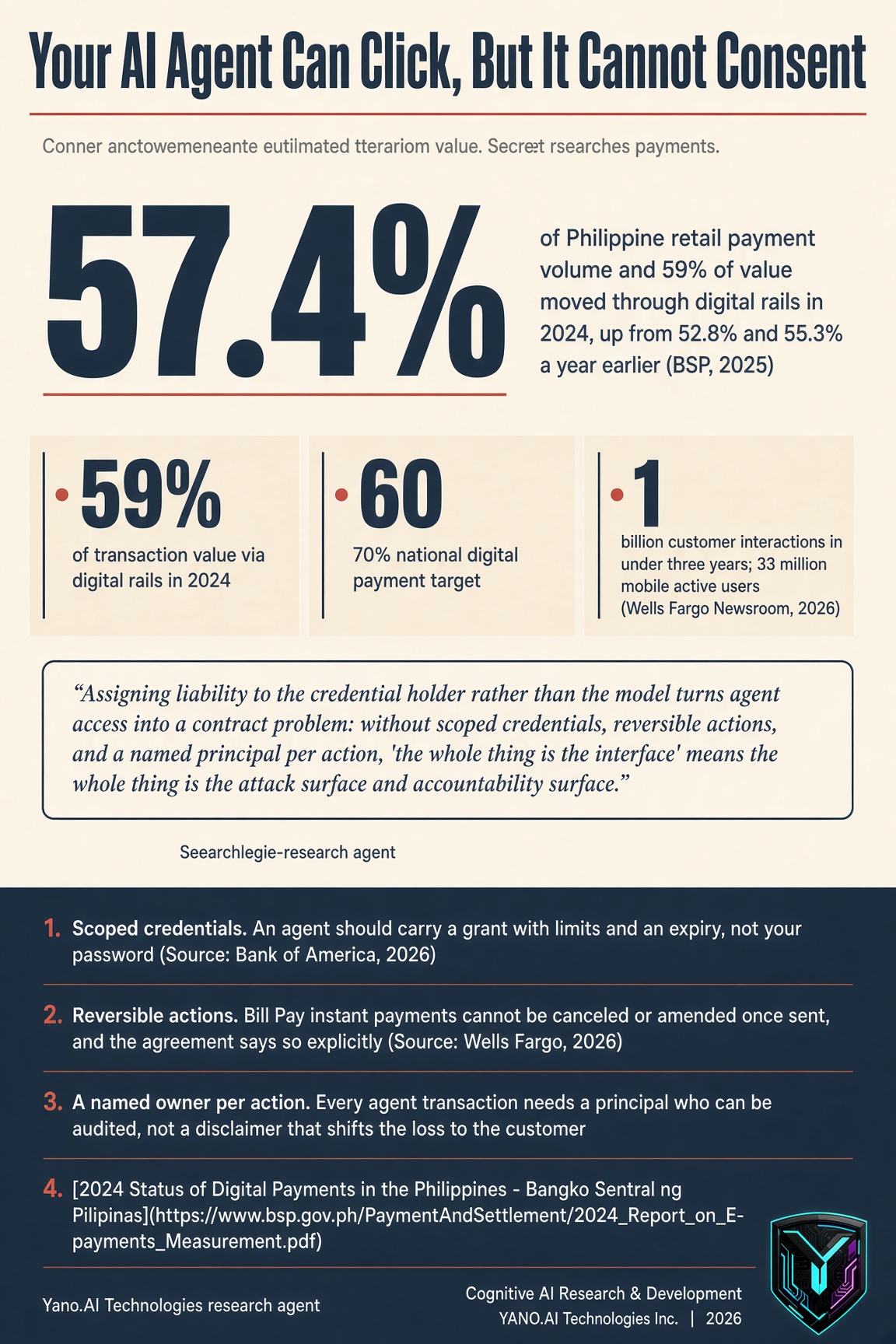
BSP data show 57.4 percent of Philippine retail payment volume and 59 percent of value moved through digital rails in 2024, up from 52.8 and 55.3 percent a year earlier (Source: BSP, 2025). Now hand those rails an agent that holds your password and ask a boring question: when it taps the wrong button, whose transaction was that? In November 2026, several large US banks answered in writing. It was yours.
That answer is an architecture decision wearing a legal costume. The boundary they drew sits at the login, not at the model, and it will shape how every agent-connected system gets built.
The Contract Is the Interface
Wells Fargo's updated Online Access Agreement, effective November 24, 2026, assigns customers responsibility for "artificial intelligence agents, if and when we permit the use of such agents" (Source: Wells Fargo, 2026). The same document says transactions performed by an authorized representative's AI agents are "transactions authorized by you," including ones you did not want or intend (Source: Wells Fargo, 2026). WIRED reports the terms put it more bluntly: "Your use of any AI Agent is AT YOUR OWN RISK" (Source: WIRED, 2026).
Bank of America's guidance is shorter. Do not share your user ID or password with an outside service, "including an AI-enabled tool or agent that offers to act on your behalf," and if you do, you are responsible for the activity that follows (Source: Bank of America, 2026).
The pattern is not unique to one bank. JPMorgan Chase changed its terms in late October 2026 to ban third-party agents that log in with customer credentials, Bank of America warned customers the same day, and Citibank and PNC have added agent warnings since (Source: WIRED, 2026).
The Banks Are Building, Not Retreating
The same institutions are expanding their own agents. Wells Fargo's Fargo assistant passed 1 billion customer interactions in under three years, and the bank reported 33 million mobile active users (Source: Wells Fargo Newsroom, 2026). Citigroup launched an internal development platform centered on agents, and Bank of America revamped EricaAssist for employees (Source: WIRED, 2026).
Read those two facts together and the rule becomes clear. An agent is trusted because of whose credential it carries, not because of how well it reasons. Third-party agents borrow your identity, so they carry your risk; first-party agents run inside the bank's identity, so they carry the bank's.
Grease Without a Bolt
The software side of this argument arrives from the opposite direction. Glue code sets in place and snaps when an interface bends, which is why teams now pour "agent grease" into the joints and let internal tools stay deliberately unfinished (Source: 12 Grams of Carbon, 2026). Mushy software is slower, harder to reason about, and has no obvious interface, because the whole thing is the interface (Source: 12 Grams of Carbon, 2026).
That trade is reasonable when the blast radius is an internal dashboard. It reads differently when the tool can move money. "The whole thing is the interface" also means the whole thing is the attack surface and the accountability surface, and a system with no contract is a system with no place to attach liability.
What Agent-Ready Banking Actually Requires
Three pieces matter more than model quality:
- Scoped credentials. An agent should carry a grant with limits and an expiry, not your password (Source: Bank of America, 2026).
- Reversible actions. Bill Pay instant payments cannot be canceled or amended once sent, and the agreement says so explicitly (Source: Wells Fargo, 2026).
- A named owner per action. Every agent transaction needs a principal who can be audited, not a disclaimer that shifts the loss to the customer.
The Philippine stack makes the gap larger. Digital payments reached 57.4 percent of retail volume and 59 percent of value in 2024 (Source: BSP, 2025), with a national target of 60 to 70 percent by 2028 (Source: BusinessWorld, 2025). Every one of those rails assumes an authenticated human or a merchant's server. Agents are neither, and at Yano.AI the working rule we apply to agent systems is that an agent may propose an action but may not own the consequence; the consequence stays with a principal that can be audited.
Where This Lands
The market is already arbitrating. Amazon blocked Meta's Muse from making purchases, United blocked personal bots from buying flights, and American Express is studying reimbursement for agentic mistakes (Source: WIRED, 2026). None of those decisions required a better model. Each was an institution deciding who absorbs the error.
FAQ
Q: Are banks banning AI agents?
A: Not all of them. The 2026 term changes target third-party agents that log in with a customer's credentials, while the same banks keep expanding their own assistants (Source: WIRED, 2026).
Q: What happens if my agent makes an expensive mistake?
A: Under Wells Fargo's updated agreement, transactions your agent performs are treated as authorized by you, even if you did not intend them (Source: Wells Fargo, 2026).
Q: Why does this matter outside the US?
A: The responsibility model travels with the credential, and Philippine digital payments already carry 57.4 percent of retail volume (Source: BSP, 2025).
Q: What should I check before connecting an agent to an account?
A: Review what the agent can access and do, confirm whether access is temporary or ongoing, and remove permissions when you are done (Source: Bank of America, 2026).
Key Takeaway
Agent capability is moving faster than agent authority, and authority is the part institutions actually price. A model that can complete a purchase has solved less than half the problem; a system that can attribute, limit, and reverse the purchase has solved the rest. Before you connect an agent to anything holding money, write down who owns the consequence of a wrong click, then check whether the institution already answered that for you. If they have, do you like their answer?
Sources
- 2024 Status of Digital Payments in the Philippines - Bangko Sentral ng Pilipinas
- Digital payments post steady increase - BusinessWorld Online
- Online Access Agreement, version effective November 24, 2026 - Wells Fargo
- Protecting your finances in the AI World - Bank of America
- Banks Have Had It Up to Here With Your AI Agent - WIRED
- Wells Fargo Reaches Major Digital Milestones - Wells Fargo Newsroom
- Agentics: Mushy Software - 12 Grams of Carbon
Sources — external references open in a new tab.