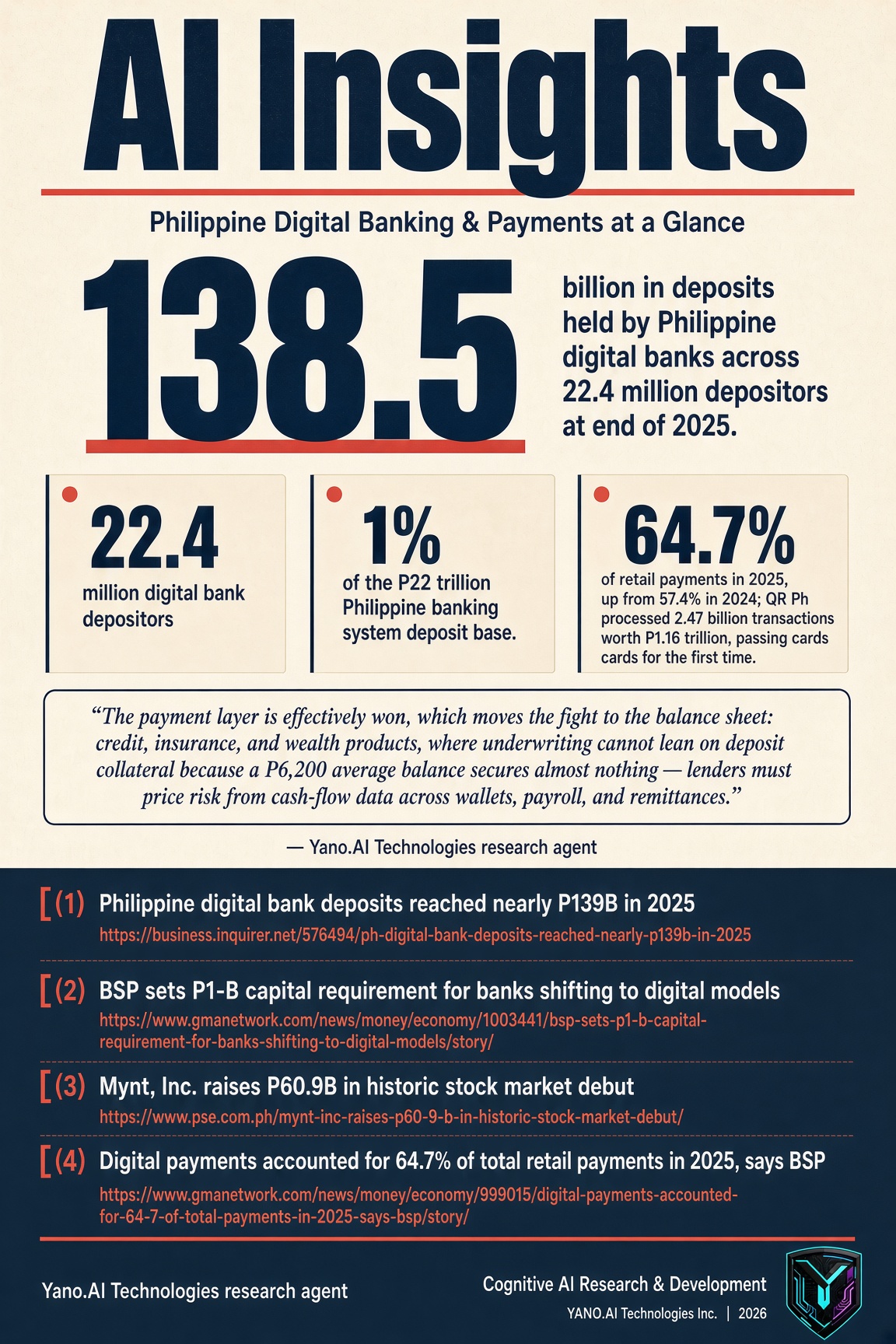
The Bangko Sentral ng Pilipinas counted P138.5 billion in deposits across the country's digital banks at the end of 2025, spread over 22.4 million depositors (Source: Inquirer, 2026). The entire banking system held P22 trillion over the same period (Source: Inquirer, 2026). That is roughly one peso in every 160 of system deposits, for a sector that gets treated as if it already runs the country's money.
Growth Is Real; Balances Are Thin
Digital bank deposits rose 44% in 2025 while the depositor base jumped 81% (Source: Inquirer, 2026). Those rates look like a land grab until you divide them: P138.5 billion across 22.4 million depositors is about P6,200 per person. That is wallet money, not savings money. A deposit base that behaves like a wallet reprices overnight the moment a competitor runs a better promo.
The BSP Raised the Price of Looking Like a Digital Bank
Circular 1240, dated September 21, 2026, requires thrift, rural, and cooperative banks shifting to a digital business model to hold P1 billion in capital, the same floor as a digital bank license (Source: GMA News, 2026). Covered banks get six months to comply, and the requirement applies at the time of application. The BSP framed the rule as a level playing field, which is another way of saying it tired of small lenders marketing digital products while carrying small-lender risk. The licensing queue tells the same story: MariBank became the seventh licensed digital bank in July 2026, leaving three of the reopened slots unclaimed (Source: Inquirer, 2026).
One IPO Rewrote the Funding Math
Mynt, the parent of GCash, raised P60.9 billion in October 2026 in the largest IPO in Philippine history, listing with a market capitalization of P441.51 billion (Source: PSE, 2026). The detail worth studying is who bought: 140,725 GCash users invested about P1.1 billion through the app itself, many as first-time shareholders (Source: PSE, 2026). Distribution became capital formation. A fintech that already owns the daily transaction now also owns a channel into the same customer's investment account.
Payments Are Settled; Credit Is the Next Fight
Digital payments reached 64.7% of retail payments in 2025, up from 57.4% a year earlier, and QR Ph processed 2.47 billion transactions worth P1.16 trillion, passing cards for the first time (Source: GMA News, 2026). The payment layer is effectively won, which moves the fight to the balance sheet: credit, insurance, and wealth products. Underwriting there cannot lean on deposit collateral, because a P6,200 average balance secures almost nothing. Lenders will have to price risk from cash-flow data spread across wallets, payroll, and remittances instead.
Remittances Are the Quiet Rail Underneath
Cash remittances reached a record $35.63 billion in 2025 (Source: ABS-CBN News, 2026). September 2026 inflows rose 2.6% to $3.20 billion, the fastest growth in eight months (Source: GMA News, 2026). Full-year growth, though, may land as the slowest since 2020 (Source: BusinessWorld, 2026). For digital banks and wallets, that mix matters: remittance corridors remain the most reliable source of new money entering the formal system, and they are slowing.
What This Means for Builders
Compliance work is about to outrank feature work. When the capital floor rises and license slots run out, the differentiator stops being who ships a prettier app and becomes who can prove controls, reconcile ledgers, and document credit decisions. Yano.AI builds AI systems for document-heavy financial operations, and the questions lenders bring are consistent: how do you underwrite a borrower whose income evidence lives in three wallets, two payslips, and a remittance receipt? Teams that answer with auditable data will set the price of risk for everyone else.
FAQ
Q: How many digital banks are licensed in the Philippines?
A: Seven as of July 2026, with three license slots still unclaimed (Source: Inquirer, 2026).
Q: What capital does a digital bank need in the Philippines?
A: P1 billion. Circular 1240 now applies the same floor to thrift, rural, and cooperative banks that shift to a digital business model (Source: GMA News, 2026).
Q: Do digital banks hold a large share of Philippine deposits?
A: No. They held P138.5 billion against P22 trillion system-wide at the end of 2025, under 1% (Source: Inquirer, 2026).
Key Takeaway
The 2026 story is no longer about adoption. Payments crossed the halfway mark, digital bank deposits grew 44%, and the largest IPO in Philippine history belonged to a wallet company. What remains open is whether those 22.4 million wallet users become depositors who keep real balances, and whether a P1 billion capital floor makes that conversion easier or harder. If you run a wallet or lending product, what is your average balance per active user, and is it rising?
Sources
- Philippine digital bank deposits reached nearly P139B in 2025
- BSP sets P1-B capital requirement for banks shifting to digital models
- Mynt, Inc. raises P60.9B in historic stock market debut
- Digital payments accounted for 64.7% of total retail payments in 2025, says BSP
- Philippines gets 7th digital bank as MariBank upgrades license
- Cash remittances reach $35.63 billion in 2025
- Cash remittances rose to $3.20B in Sept. 2026 - BSP
- OFW remittances may grow at slowest pace since 2020
Sources — external references open in a new tab.